Most landlords estimate their tax bill on a sale by thinking about capital gains alone — sale price minus what they paid, taxed at 15% or 20%. That estimate is usually low, sometimes by tens of thousands of dollars, because a rental sale actually triggers up to three separate taxes stacked on top of each other, and two of them are frequently forgotten entirely until the closing statement or the following April.
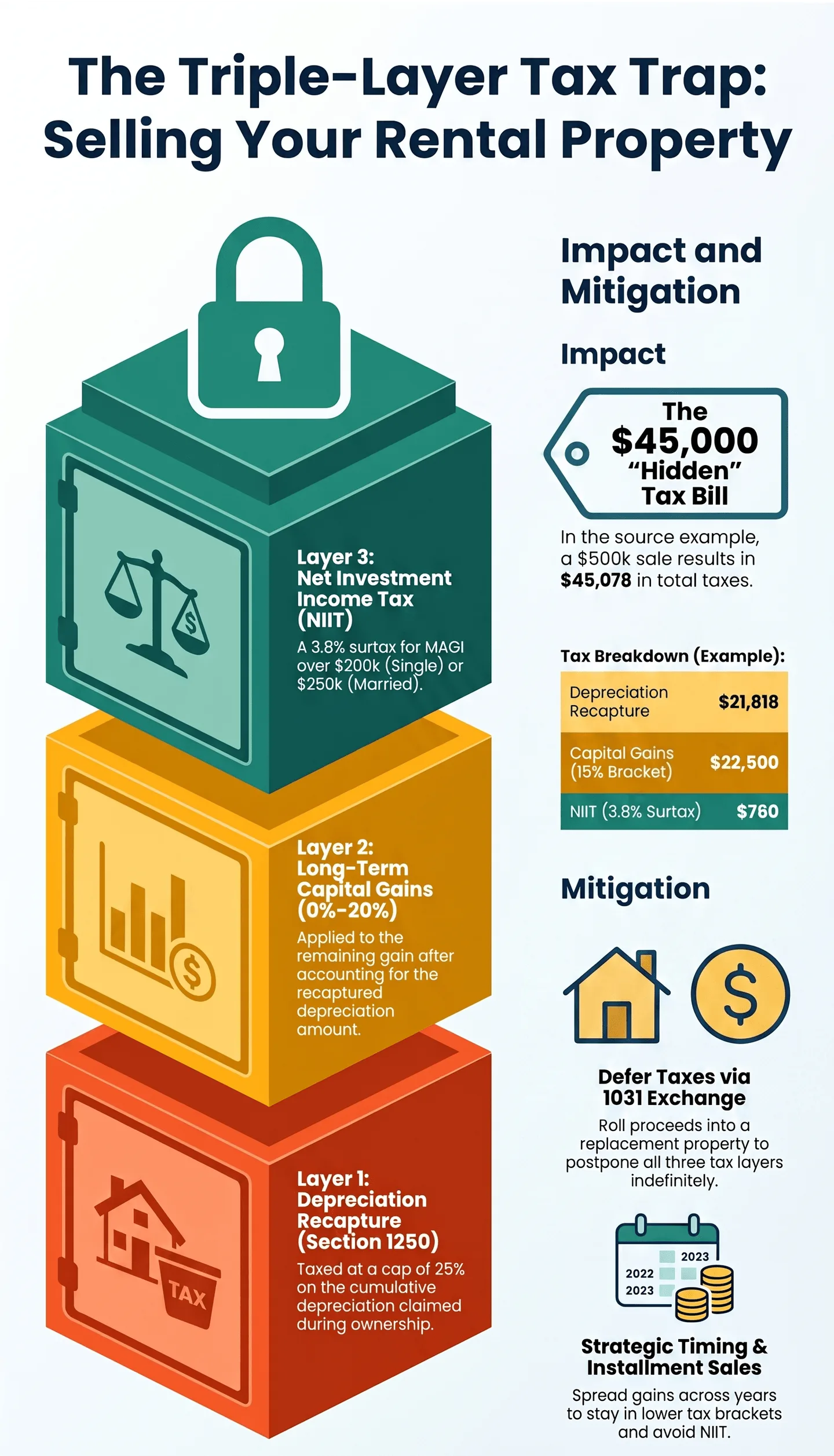
The Three Layers, In the Order They Apply
Layer 1: Depreciation Recapture. Every year you owned the property, depreciation reduced your taxable rental income — or should have, whether you claimed it or not (see our related article on the depreciation recapture trap). At sale, that cumulative depreciation is taxed separately as "unrecaptured Section 1250 gain," at a rate capped at 25% — this portion is taxed first, before the remaining gain moves to capital gains treatment.
Layer 2: Long-Term Capital Gains. Whatever gain remains after accounting for the recaptured depreciation is taxed at standard long-term capital gains rates — 0%, 15%, or 20%, depending on your total taxable income for the year, assuming you held the property more than one year.
Layer 3: Net Investment Income Tax (NIIT). If your modified adjusted gross income exceeds $200,000 (single) or $250,000 (married filing jointly), an additional 3.8% surtax applies on top of both the recapture and capital gains portions — this threshold has never been adjusted for inflation since it was set in 2013, which means more landlords cross it every year even without a real increase in purchasing power.
The 2026 Numbers That Determine Your Rate
- Depreciation recapture (Section 1250): capped at 25%, but can be lower depending on your ordinary income bracket
- Long-term capital gains: 0% up to $49,450 taxable income (single) / $98,900 (married filing jointly); 15% up to $545,500 / $613,700; 20% above that
- NIIT: 3.8% on the lesser of your net investment income or the amount your MAGI exceeds $200,000 (single) / $250,000 (MFJ)
These capital gains brackets apply to your taxable income — after your standard deduction ($16,100 single / $32,200 MFJ for 2026) — not your gross income, which is why some landlords with substantial gross income still land in a lower bracket than they expect.
A Complete Worked Example
A single landlord sells a rental for $500,000. They bought it for $350,000 and claimed $87,270 in depreciation over their ownership period (roughly 10 years on a $240,000 depreciable basis, following the math from our depreciation recapture article). Their total taxable income for the year, including the sale, comes to $220,000.
Step 1 — Calculate total gain: Sale price ($500,000) minus adjusted basis (original cost of $350,000 minus depreciation of $87,270, equaling $262,730 adjusted basis) = $237,270 total gain
Step 2 — Separate the recapture portion: The $87,270 in depreciation claimed becomes unrecaptured Section 1250 gain, taxed at up to 25%. At this landlord's income level, assume the full 25% applies: $87,270 × 25% = $21,818 in recapture tax
Step 3 — Tax the remaining capital gain: $237,270 total gain − $87,270 recapture portion = $150,000 in standard long-term capital gain. At $220,000 taxable income (single filer), this falls in the 15% bracket: $150,000 × 15% = $22,500 in capital gains tax
Step 4 — Apply NIIT if applicable: This landlord's MAGI of $220,000 exceeds the $200,000 single-filer threshold by $20,000. NIIT applies to the lesser of net investment income ($237,270) or the excess over the threshold ($20,000) — so NIIT applies to $20,000: $20,000 × 3.8% = $760 in NIIT
Total tax on this sale: $21,818 + $22,500 + $760 = $45,078 — an effective rate of roughly 19% on the total $237,270 gain, but composed of three separate calculations most landlords never see broken out individually until they're already looking at a completed return.
Why This Catches People Off Guard
The recapture tax is the piece that surprises people most, because it applies specifically to depreciation deductions — the same deductions that reduced their taxable income every year they owned the property. It can feel like being taxed twice on the same money: once by having a smaller current deduction available in later years as the depreciation runs out, and again at sale on the same depreciation that already provided a benefit. This is by design in the tax code, not an error, but it's rarely explained clearly before the sale happens.
The NIIT piece surprises higher earners specifically because the $200,000/$250,000 thresholds have never moved since 2013 — a landlord who wouldn't have owed NIIT a decade ago at the same real income level may cross the threshold today purely from inflation-driven income growth, with no corresponding adjustment to the threshold itself.
Ways to Manage This Bill Before You Sell
A 1031 exchange defers all three layers by rolling your proceeds into a replacement property — it doesn't eliminate the liability, but postpones it, potentially indefinitely if you continue exchanging or until a stepped-up basis at death eliminates it for your heirs entirely.
Timing the sale around your income matters more than most landlords realize — selling in a year when your other income is lower can meaningfully shift which capital gains bracket applies to the non-recapture portion of your gain, and can keep you under the NIIT threshold entirely in some cases.
Installment sales can spread a gain across multiple tax years if the transaction is structured that way, potentially keeping you in lower brackets in each individual year rather than concentrating the entire gain — and its associated NIIT and bracket exposure — into a single tax year.
Run your specific numbers, including your actual depreciation history and expected sale price, through our Sell vs Keep Calculator to see this full three-layer calculation applied to your situation before you list.
Frequently Asked Questions
Can I avoid depreciation recapture by not selling and just holding the property forever? Recapture is only triggered by a taxable sale, so avoiding a sale avoids the tax — but that's a decision to hold real estate indefinitely, not a tax-avoidance strategy on its own. If you hold until death, your heirs receive a stepped-up basis under IRC §1014, which effectively eliminates both the recapture and capital gains liability that accumulated during your ownership — a legitimate and common estate planning outcome for long-held rental property.
Does NIIT apply to the entire gain, or just the portion above the threshold? NIIT applies to the lesser of your total net investment income or the amount your MAGI exceeds the threshold — not automatically to your entire investment income. In the worked example above, the landlord's gain was $237,270, but NIIT only applied to $20,000 (the amount their MAGI exceeded the $200,000 threshold), not the full gain.
Is depreciation recapture calculated the same way for a short-term rental as a long-term rental? Yes — recapture applies based on depreciation claimed or allowable regardless of whether the property was operated as a long-term rental or short-term rental, and regardless of whether you used the STR loophole to offset active income during ownership (see our related article on the STR loophole). Using accelerated depreciation through cost segregation during ownership generally increases your recapture exposure at sale, since more depreciation was claimed overall.
What if I sell at a loss — do any of these three layers still apply? Depreciation recapture can still apply even in a transaction that feels like a loss relative to your original purchase price, because recapture is calculated against your depreciated basis, not your original cost. Capital gains tax and NIIT, however, only apply if there's an actual gain after accounting for recapture — a genuine loss on the capital gains portion isn't taxed and may even be deductible against other capital gains, subject to passive activity loss rules.