Here's a piece of landlord folk wisdom that sounds smart and is actually one of the most expensive mistakes in real estate taxation: "I don't claim depreciation, so I won't owe recapture tax when I sell." Every part of that sentence except the first four words is wrong — and the gap between what people believe and what the IRS actually does can cost tens of thousands of dollars.
The Rule That Surprises Almost Every Landlord Who Skips Depreciation
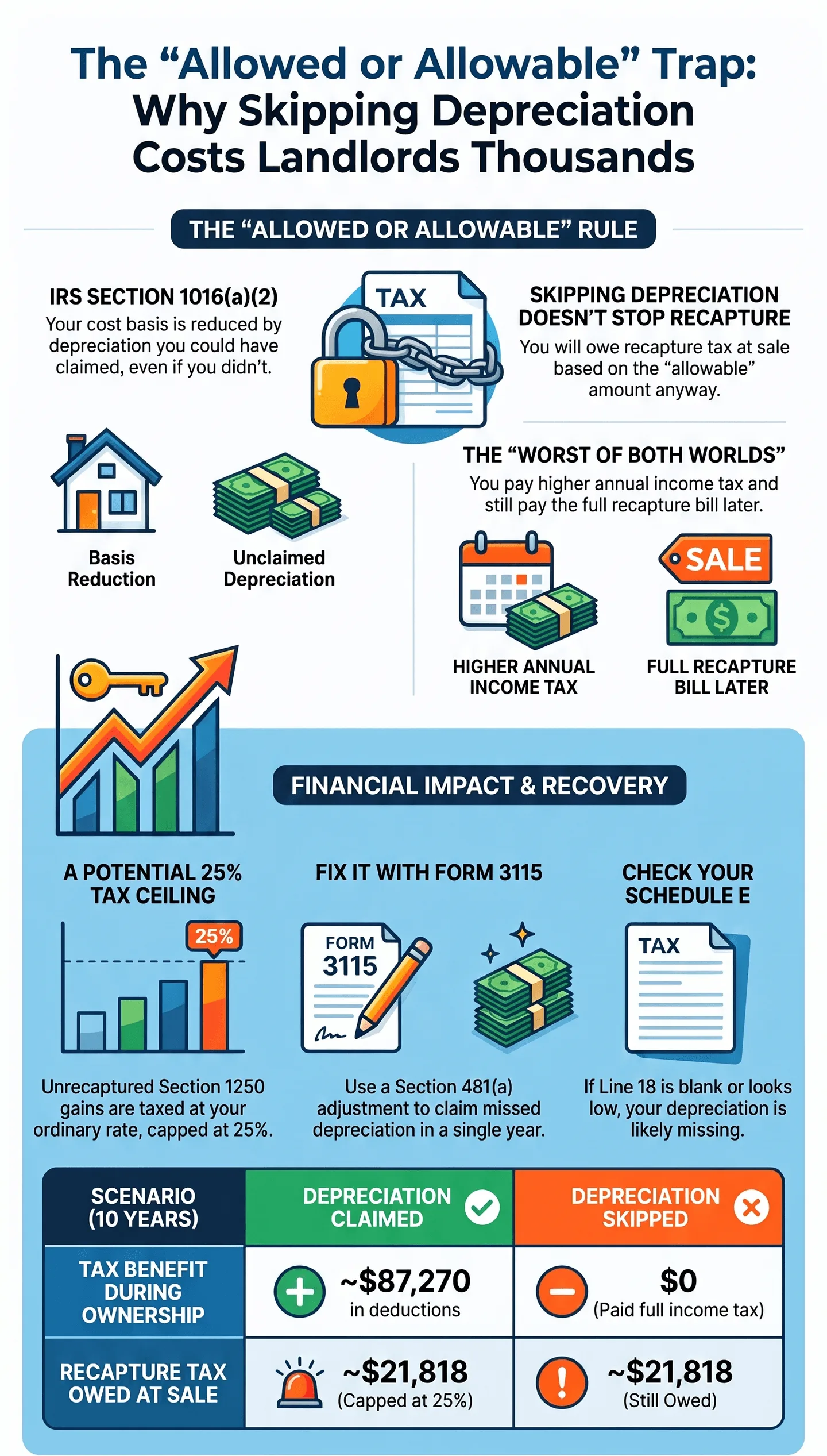
The IRS uses what's called the "allowed or allowable" rule, spelled out in Publication 946 and IRC Section 1016(a)(2): when you sell a rental property, your cost basis is reduced by the depreciation you were entitled to claim — whether you actually claimed it or not. "Allowable" depreciation counts exactly the same as "allowed" (claimed) depreciation for this calculation.
In plain terms: the IRS doesn't ask whether you took the deduction. It asks whether you could have. If the answer is yes, you owe recapture tax on that amount at sale — even if you never got a single dollar of annual tax benefit from it while you owned the property.
Why This Makes Skipping Depreciation the Worst Possible Choice
Think through what actually happens if you don't claim depreciation:
- During ownership: You pay more tax every year than you needed to, because you're not using the deduction that would have reduced your taxable rental income
- At sale: The IRS still reduces your basis as if you'd claimed it, and you still owe recapture tax on that amount
You get zero benefit and pay the same bill anyway. As one CPA guide bluntly puts it, skipping depreciation means "you are paying tax on phantom deductions. It is the worst of both worlds."
What the Numbers Actually Look Like
Take a landlord who bought a rental with a $240,000 depreciable basis (building value only, not land) and never claimed depreciation over 10 years of ownership. The annual depreciation they were entitled to — but didn't take — comes to roughly $8,727/year, or about $87,270 total over the decade.
When this landlord sells, the IRS calculates their adjusted basis as if they'd claimed all $87,270 in depreciation. That $87,270 becomes taxable "unrecaptured Section 1250 gain," taxed at up to 25% — meaning roughly $21,818 in recapture tax on deductions they never actually benefited from. They paid full income tax on their rental profits for a decade, and now they're paying recapture tax on top of it, for a deduction they simply never used.
The 25% Rate Is a Ceiling, Not a Flat Rate — A Detail Most Guides Get Wrong
Many articles describe the recapture rate as a flat 25%. It's more precise to say it's capped at a maximum of 25% — the actual rate you pay on unrecaptured Section 1250 gain depends on your ordinary income tax bracket, and can be lower for taxpayers in lower brackets, though it never exceeds 25%. If your overall tax situation would otherwise put you in a lower bracket for this income, you may pay less than the maximum — but 25% is the number to budget for as a worst-case planning figure.
If You've Already Made This Mistake, There's a Fix
If you're reading this and realizing you haven't been claiming depreciation, the situation is recoverable — but it requires action before you sell, not after. Form 3115 (Application for Change in Accounting Method) allows you to correct missed depreciation from prior years through what's called a Section 481(a) adjustment, often letting you claim the full catch-up amount in a single tax year rather than losing it permanently.
This is not a do-it-yourself form. The calculation involves reconstructing your depreciation history correctly and understanding how the catch-up adjustment interacts with your current-year return. This is squarely CPA territory, and the earlier you address it — ideally years before a planned sale, not the year you list the property — the more options you have.
Depreciation Recapture Doesn't Care How You Sell
A related myth worth clearing up directly: selling at a loss doesn't eliminate recapture tax. Recapture is calculated on the depreciation you claimed (or could have claimed), not on whether the overall transaction was profitable. If you depreciated a property by $50,000 over your ownership and then sell at what feels like a loss relative to your original purchase price plus improvements, you can still owe recapture tax on that $50,000 if your adjusted basis calculation shows a gain relative to the depreciated basis, even when your gut sense of the sale is "I lost money."
Frequently Asked Questions
If I never claimed depreciation, can I just skip Form 3115 and continue not claiming it? You can choose not to file the correction, but this doesn't change your recapture liability at sale — the IRS calculates recapture based on allowable depreciation regardless of what you actually claimed. Skipping Form 3115 simply means you permanently lose the tax benefit of those deductions while still owing recapture tax on the same amount. There's no scenario where continuing to skip depreciation helps you.
Does depreciation recapture apply if I sell at a loss overall? Recapture is calculated based on your adjusted basis (original cost minus depreciation claimed or allowable) compared to your sale price — not based on your original purchase price. It's possible to have a loss relative to your original investment while still owing recapture tax, because the depreciation deductions you took over the years reduced your basis enough to create a technical gain in the recapture calculation.
Can a 1031 exchange help me avoid this recapture bill entirely? A 1031 exchange defers both the capital gains tax and the depreciation recapture tax by rolling your proceeds into a replacement property — it doesn't eliminate the liability, it postpones it. The deferred amount carries forward into the new property's basis. Many investors chain multiple 1031 exchanges over a lifetime and ultimately benefit from a stepped-up basis at death, which effectively eliminates the recapture liability for their heirs. See our Sell vs Keep Calculator to model your specific numbers.
How do I know if I've been claiming depreciation correctly? Check Line 18 of your most recent Schedule E — you should see a depreciation deduction there each year you've owned the rental. If that line is blank, or the amount seems far lower than roughly 3.6% of your building's value per year, your depreciation may not be set up correctly. This is worth confirming with a CPA before your next filing, and definitely before any sale.