Your rental property shows a $20,000 tax loss this year — mostly from depreciation, maybe some repairs. On paper, that looks like a $20,000 deduction against your W-2 income. Whether that's actually true depends entirely on one number: your modified adjusted gross income. Get this wrong, and you'll either overestimate your tax savings or miss deductions you were entitled to.
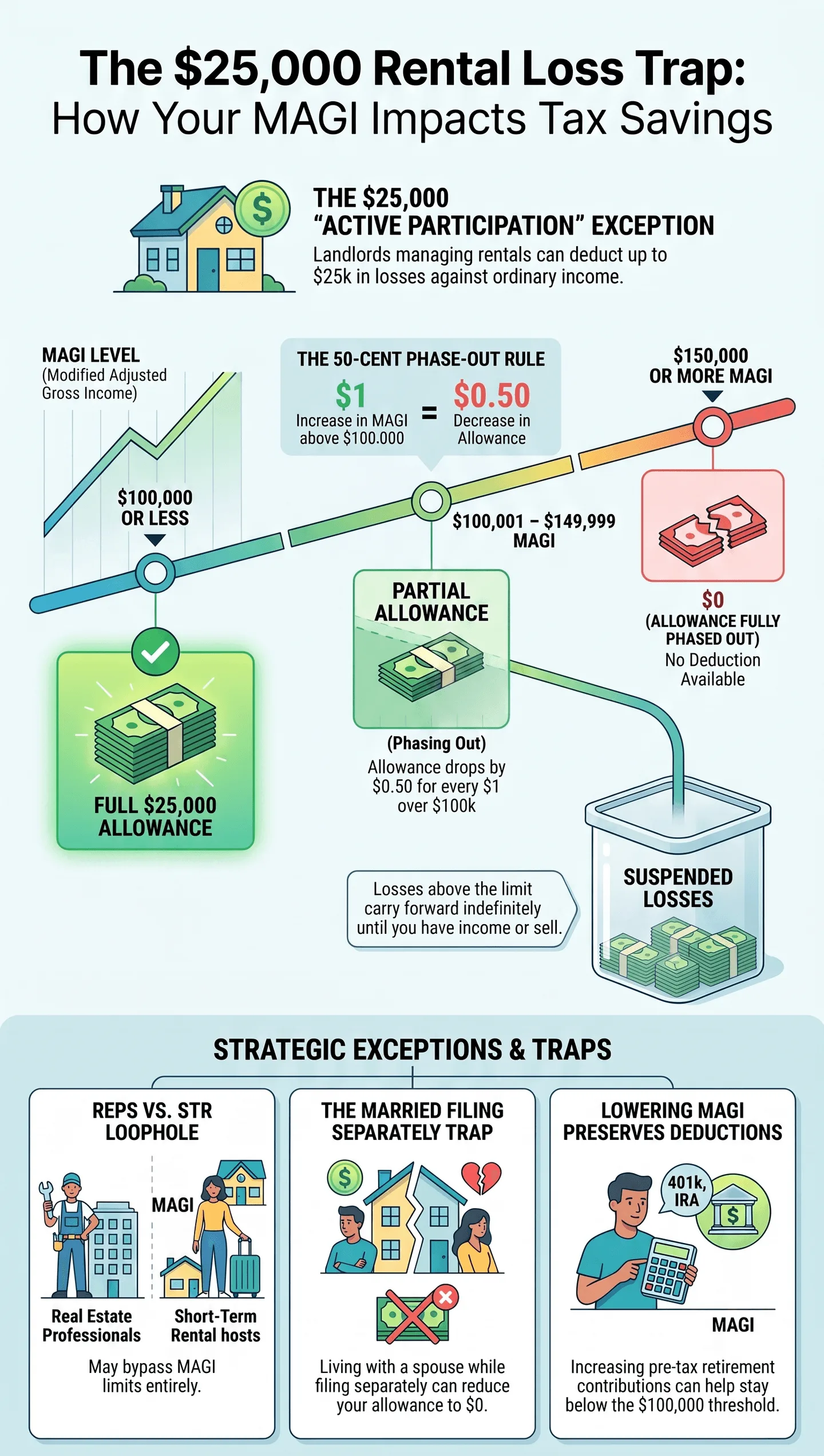
The Default Rule: Rental Losses Are Passive, and Passive Stays Passive
Under IRC Section 469, rental real estate is classified as a passive activity by default — even if you're the one dealing with tenants, repairs, and every management decision. The general rule is that passive losses can only offset passive income, not your wages, self-employment income, or other active earnings. This is why a rental loss doesn't automatically reduce your day-job tax bill.
The $25,000 Exception — And the Number That Controls It
Congress carved out a specific exception for landlords: if you actively participate in managing your rental (a lower bar than "material participation" — setting rent, approving tenants, and authorizing repairs generally qualifies, even if you use a property manager for day-to-day work), you can deduct up to $25,000 of rental losses against your ordinary income.
This allowance is fully available only below a specific income threshold, and it's not a cliff — it's a gradual phase-out. Per IRS Publication 925:
- MAGI $100,000 or less: Full $25,000 allowance available
- MAGI $100,000–$150,000: The allowance is reduced by 50 cents for every dollar your MAGI exceeds $100,000
- MAGI $150,000 or more: The allowance is $0 — completely phased out
The Math, Worked Through
The phase-out formula is straightforward once you see it applied: subtract $100,000 from your MAGI, divide by 2, and subtract that from $25,000.
Take a landlord with $120,000 in MAGI and an $18,000 rental loss from active participation:
- MAGI exceeds $100,000 by $20,000
- Reduction: $20,000 × 50% = $10,000
- Allowance remaining: $25,000 − $10,000 = $15,000
- Since the actual loss ($18,000) exceeds the allowance ($15,000), this landlord can deduct $15,000 against ordinary income this year — the remaining $3,000 doesn't disappear, it carries forward (more on that below)
At MAGI of $150,000 or above, this same landlord would deduct nothing against ordinary income this year, regardless of how large the rental loss is — the entire loss would be suspended.
Suspended Losses Aren't Lost — They're Waiting
This is the detail that makes the $25,000 limit less alarming than it first sounds. Any rental loss that exceeds your available allowance doesn't vanish — it becomes a suspended passive loss, tracked on Form 8582, and carries forward indefinitely to future tax years. You can use suspended losses to offset passive income in a later year when you have some, or — more commonly for landlords — the entire suspended balance becomes fully deductible in the year you sell the property, regardless of your MAGI at that time.
This means high earners who are permanently phased out of the $25,000 allowance aren't losing their depreciation deductions — they're deferring the tax benefit until sale, which is worth factoring into your decision using our Sell vs Keep Calculator.
The Married Filing Separately Trap
If you're married and file separately, this allowance shrinks dramatically — and the rules depend on whether you lived with your spouse during the year:
- Lived apart the entire year: Maximum allowance is $12,500, phasing out between $50,000 and $75,000 MAGI (exactly half of the standard thresholds)
- Lived together at any point during the year: The allowance is $0 — no special allowance at all, regardless of income
This second rule catches people off guard. Married couples who file separately for reasons unrelated to their rental activity (student loan repayment strategies are a common one) can inadvertently forfeit this entire deduction if they lived together for even part of the year.
The Way Around the Phase-Out Entirely: Real Estate Professional Status
If your MAGI is well above $150,000, the $25,000 allowance isn't available to you at all under the active participation rules — but there's a separate, more demanding path that removes the limitation entirely. Real estate professional status (IRC Section 469(c)(7)) requires that more than half of your total working hours, and at least 750 hours during the year, go toward real property trades or businesses in which you materially participate. Qualify for this status, and your rental activities are no longer treated as passive at all — losses can offset W-2 wages or business income without any MAGI restriction whatsoever.
This is a high bar — generally impractical for someone working a full-time W-2 job unrelated to real estate — but it's the standard path for landlords whose primary occupation is real estate investing or management.
The Short-Term Rental Exception Is a Separate, Easier Path
For landlords who don't qualify as real estate professionals, there's a narrower but more achievable exception: short-term rentals with an average guest stay of 7 days or less aren't automatically classified as rental activities under passive activity rules. If you materially participate in managing that specific property (a different, somewhat lower bar than real estate professional status), losses from that STR can offset active income without the $25,000 cap or MAGI phase-out — this is the mechanism behind what's often called the "STR loophole." See our Airbnb Host Tax Classifier to check whether your short-term rental qualifies.
Frequently Asked Questions
Does the $25,000 allowance apply per property or across all my rentals combined? It applies to your combined passive losses across all rental real estate activities in which you actively participate, not per individual property. If you own three rentals and two show losses while one shows income, the losses are combined for purposes of the $25,000 allowance calculation.
What exactly counts toward MAGI for this calculation? For this specific purpose, MAGI is your adjusted gross income calculated without certain items added back, including taxable Social Security benefits and deductible IRA contributions. For most landlords without those specific circumstances, MAGI for this calculation is very close to regular AGI — but it's worth confirming with a CPA if you have significant retirement contributions or Social Security income in the mix.
If my MAGI fluctuates near $100,000, is there anything I can do to preserve the full allowance? Reducing your MAGI in a given year — through increased pre-tax retirement contributions, for example — can help you stay under or closer to the $100,000 threshold and preserve more of the $25,000 allowance. This is a legitimate planning consideration worth discussing with a CPA if your income tends to hover near this threshold, since the difference between $99,000 and $101,000 MAGI has real tax consequences on your rental loss deductibility.
Do suspended passive losses expire if I don't use them for many years? No — suspended passive losses carry forward indefinitely under current law. There's no expiration date. They remain available to offset future passive income or to be fully released when you dispose of the property in a fully taxable transaction, even if that's a decade or more after the loss was originally suspended.