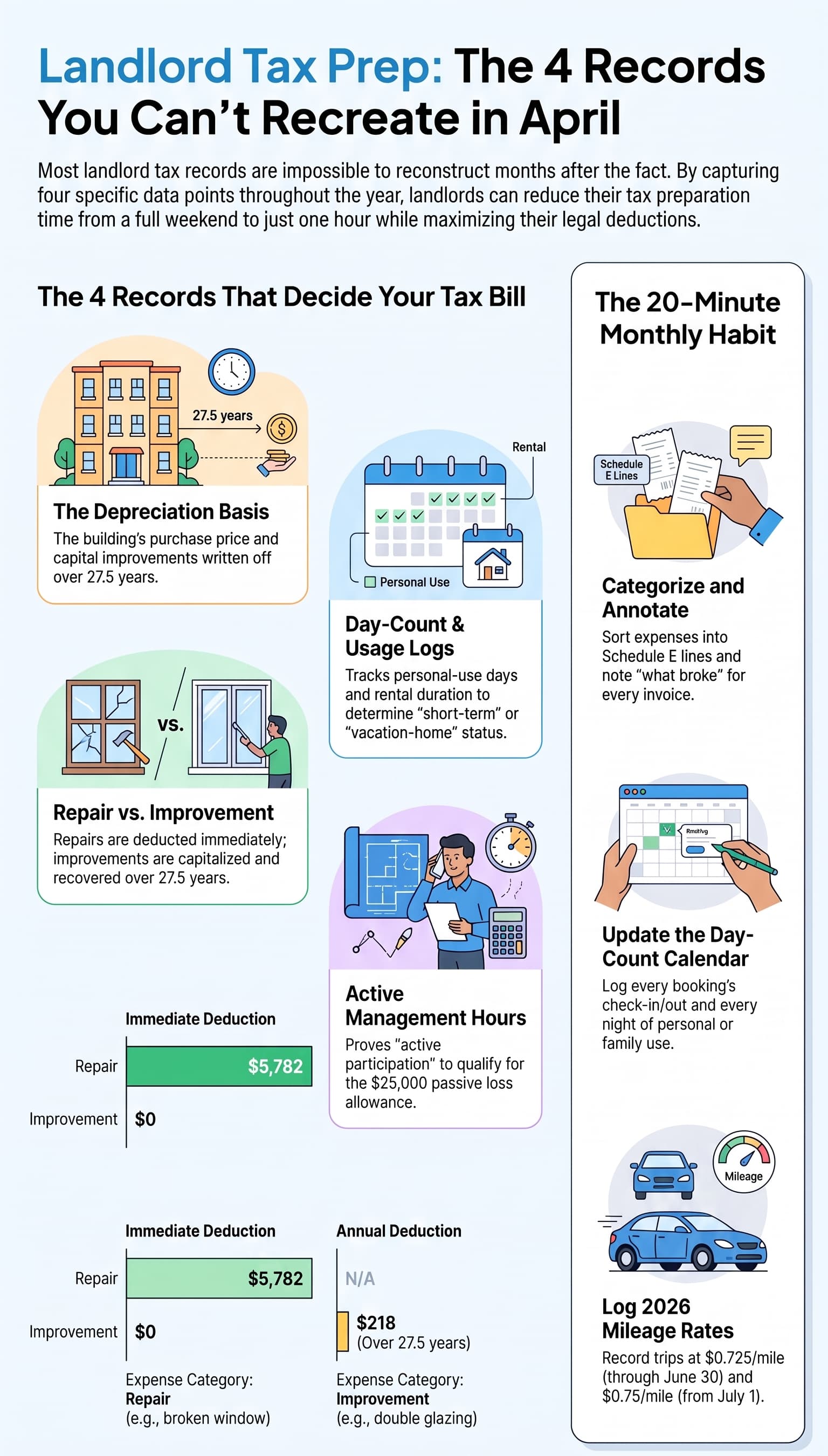
Four records decide most of a landlord's tax bill: the depreciation basis of each property, whether each spend was a repair or an improvement, the days each property was rented versus used personally, and the hours spent managing it. Only the first can be reconstructed in April. The other three are gone if nobody wrote them down as the year went.
Record one: the depreciation basis, set once and kept forever
Depreciation is the largest deduction most rentals produce, and it comes from a number fixed at purchase: the building's share of the cost, written off over 27.5 years.
Keep the closing statement, the purchase price, the land-versus-building allocation, and every capital improvement with its date and cost. A $185,000 purchase with 80% allocated to the building deducts $185,000 × 80% ÷ 27.5 = $5,382 a year.
Keep it until years after you sell, because the sale is when it matters most: depreciation is recaptured at up to 25%, and the IRS applies it to depreciation allowed or allowable — the deduction you could have taken, whether or not you did. Skipping it does not avoid the bill; it forfeits the deduction and keeps the tax. That trap is worked through in the depreciation mistake that costs landlords thousands.
Record two: repair or improvement, decided at the time
A repair is deducted this year. An improvement is capitalised and recovered over 27.5 years. The difference on a $6,000 spend is roughly $5,782 of deduction now versus $218 a year — and it is decided by facts nobody remembers a year later.
Write down, per spend: what broke, what was done, and whether the property is better than before or merely working again. Replacing a broken window is a repair. Replacing every window with double glazing is an improvement. Same trade, same invoice format, different tax treatment, and the invoice alone rarely says which.
The $2,500 de minimis safe harbor settles many of these outright — an item at or under that per invoice can be expensed rather than capitalised. That makes the invoice's per-item detail worth insisting on when the work is done, not requesting a year later.
Record three: days rented and days used personally
This is the record almost nobody keeps, and for a short-term rental it decides which tax form you file.
Two separate day counts matter:
- Personal-use days above 14 (or 10% of rental days, whichever is greater) pull the property into vacation-home territory and start limiting deductions.
- Average stay of 7 days or less takes the property out of the default passive rental rules entirely — which, combined with material participation, is what people mean by the short-term rental loophole.
An average is not something you estimate. It comes from a calendar with every booking's check-in and check-out, plus every night you or family stayed there. Keep that log per property from day one; there is no way to build it afterwards. The two thresholds are separated in 14-day rule vs 7-day rule.
Record four: your management hours
Rental losses are normally passive and cannot offset wage income. The exception most small landlords rely on is the $25,000 allowance for active participation — and it phases out between $100,000 and $150,000 of modified AGI, disappearing entirely above the top of that range.
Active participation means real involvement: approving tenants, setting rents, approving repairs. Keep a simple dated log of those decisions. If you are pursuing the short-term rental route instead, the hours bar is far higher and the log matters correspondingly more. The allowance and its phase-out are covered in the $25,000 passive loss trap.
What the monthly habit looks like
Twenty minutes a month, per property:
- Record rent received, and note any month it was not — vacancy is part of the picture your preparer needs.
- Categorise every expense against the Schedule E lines: advertising, auto and travel, cleaning and maintenance, insurance, legal and professional, management fees, mortgage interest, repairs, supplies, taxes, utilities.
- Attach the invoice, and for anything structural add the one-line repair-or-improvement note.
- Update the day-count calendar.
- Log any management decision you made.
Everything above is per property, not per portfolio. Schedule E has a column for each, and merging two properties into one set of books means separating them again later, from memory.
What a preparer actually wants in January
- Per property: address, purchase date, purchase price, land/building split, and the date it was placed in service
- Rent received, by property and by month
- Expenses categorised to the Schedule E lines, with backup
- Capital improvements with dates and amounts, kept separate from repairs
- The day-count log for anything short-term
- Mortgage interest statements
- Last year's depreciation schedule — this is the one document that carries forward, and it is the one most often missing when a landlord changes preparers
Frequently Asked Questions
How long do I keep records for a rental I still own?
Ordinary income and expense records follow the usual three-year rule, but anything establishing basis — the closing statement, capital improvements, the depreciation schedule — must survive until several years after you sell. That is when recapture is calculated, and it can be decades after the purchase. Keep basis documents permanently; they are a handful of files.
My property manager sends statements. Is that enough?
For rent and the expenses they handle, largely yes. It will not cover what you pay directly, your mileage to the property, or your management-decision log — and it will not tell your preparer which spends were improvements. Keep the statements and keep your own record alongside them.
Do I need to track days if I rent long-term only?
If it is rented year-round to a tenant and you never stay there, the day counts are not doing any work. The moment there is any personal use, or any short-term letting, they decide the tax treatment — so the log costs nothing to keep and is impossible to recreate.
Can I deduct driving to my rental?
Trips for a genuine rental purpose — inspections, repairs, showings, meeting a contractor — are deductible, at the same rates that changed mid-2026: $0.725 through June 30, $0.76 from July 1. Log each trip with its date and purpose. Driving past to look at it is not a business trip.
What if I have not been keeping any of this?
Start now, and separately rebuild what evidence still exists — bank records, invoices from contractors, booking platform histories, the closing file. A partial year documented properly is worth more than a full year of estimates, and the depreciation basis is usually recoverable from the closing statement no matter how long ago you bought.
See What the Records Add Up To
Records are the input. The output is what the property actually costs you after depreciation, and whether the loss is one you can use this year.
The Landlord Tax Estimator takes rent, expenses, purchase price and your MAGI and returns the taxable result — including the depreciation deduction and whether the $25,000 allowance is available at your income.