Search "Airbnb tax rules" and you'll run into a wall of numbers — a 14-day rule, a 7-day rule, sometimes an 80/20 rule or a 75/55 rule thrown in. Most hosts end up conflating them into one vague sense that "short stays mean something tax-related." They're actually two completely separate provisions, from two different parts of the tax code, answering two entirely different questions. Mixing them up is one of the most common — and most expensive — misunderstandings in short-term rental taxation.
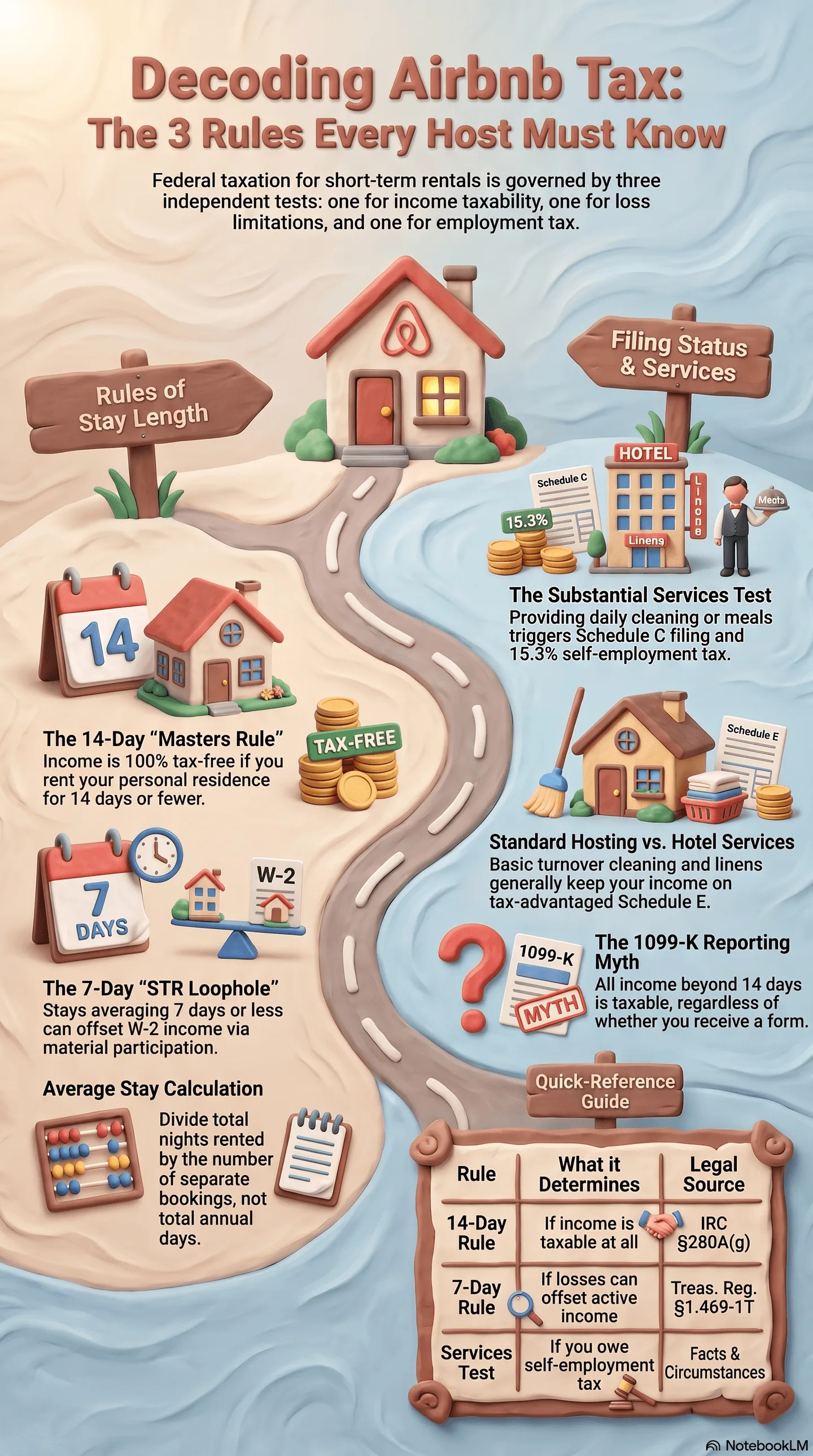
The 14-Day Rule: Is Your Income Taxable At All?
The 14-day rule (also called the "Masters Rule," after Augusta, Georgia homeowners who rent out their homes during the Masters golf tournament) comes from IRC Section 280A(g). It answers one specific question: is this rental income taxable in the first place?
If you rent your personal residence for 14 days or fewer during the year, that income is completely excluded from federal taxation — not reduced, not deferred, entirely tax-free, with no reporting required. The trade-off: you can't deduct any rental-related expenses for that period.
The critical limitation most online summaries skip: this rule applies to your personal residence, not to a dedicated short-term rental business. If you own a property specifically to operate as an Airbnb — not a home you actually live in and occasionally rent out — the 14-day rule generally doesn't apply to you, regardless of how few days you rent it.
The 7-Day Rule: Is This a "Rental Activity" For Loss Purposes?
The 7-day rule comes from an entirely different source — Treasury Regulation §1.469-1T(e)(3)(ii), part of the passive activity loss regulations. It answers a completely different question: is this property classified as a "rental activity" for purposes of the passive loss limitations?
If a property's average guest stay is 7 days or less, it is not automatically treated as a rental activity under the passive activity rules — regardless of whether it's your personal residence or a dedicated STR business. This matters because "rental activities" are automatically passive by default, but properties that fall outside that classification can become non-passive if you materially participate, which removes the $25,000 passive loss cap entirely.
This is the mechanism behind what's often called the "STR loophole": average stay of 7 days or less, plus material participation (generally 100+ hours/year and more than anyone else involved), means losses from cost segregation and accelerated depreciation can offset W-2 wages or other active income without the usual passive loss restrictions.
The Rule That Trips Up Even Careful Hosts: Neither One Decides Schedule C vs. E
Here's the mistake that shows up constantly in host forums and even some tax content: assuming the 7-day rule determines whether you file Schedule C or Schedule E. It doesn't — at least not by itself.
The Schedule C vs. Schedule E determination depends primarily on whether you provide "substantial services" to guests — hotel-like offerings such as daily housekeeping during a stay (not just between guests), meals, concierge services, or arranged transportation. Provide substantial services, and you're generally on Schedule C with 15.3% self-employment tax exposure, regardless of your average stay length. Provide only standard hosting — turnover cleaning, linens at check-in, basic amenities — and you generally stay on Schedule E, avoiding self-employment tax, even with an average stay under 7 days.
A short average stay and substantial services often show up together in practice (hosts running boutique, high-service short-term rentals), which is likely why the two get conflated. But they're legally independent tests. You can have a 3-night average stay with zero substantial services (self-service check-in, no on-property staff) and remain on Schedule E. You can also have a 21-night average stay and still land on Schedule C if you're providing daily housekeeping and meals.
Putting the Three Rules Together
| Rule | Source | What It Determines |
|---|---|---|
| 14-Day Rule | IRC §280A(g) | Whether the income is taxable at all (personal residence only) |
| 7-Day Rule | Treas. Reg. §1.469-1T | Whether the property is a "rental activity" for passive loss purposes |
| Substantial Services Test | Facts and circumstances | Whether you file Schedule C (SE tax) or Schedule E (no SE tax) |
A single property's tax treatment often requires checking all three independently — and getting one right doesn't tell you the answer to the others. Use our Airbnb Host Tax Classifier to run your specific numbers through all three tests at once, rather than trying to reason through them individually.
A Reporting Reminder That Applies Regardless of Which Rules You Meet
Whether or not you receive a Form 1099-K from your hosting platform doesn't change your underlying tax obligation. All hosting income beyond the 14-day exclusion is taxable and reportable whether or not a form arrives — platforms report payment data to the IRS independently of whether you personally receive a copy.
Frequently Asked Questions
If my average stay is under 7 days, do I automatically avoid self-employment tax? No — the 7-day rule affects whether your rental losses are treated as passive or non-passive for loss-offsetting purposes. It has no direct bearing on self-employment tax, which is determined by whether you provide substantial services to guests. A short average stay with no substantial services stays on Schedule E with no SE tax; a short average stay with substantial services lands on Schedule C with SE tax.
I own a dedicated Airbnb property, not my personal home. Does the 14-day rule apply to me? Generally no — the 14-day rule under IRC §280A(g) is written for personal residences that are occasionally rented, not for properties acquired and operated specifically as short-term rental businesses. If your property is a dedicated STR investment rather than a home you actually live in, this exclusion typically isn't available to you, regardless of how few nights you rent it.
Can I use both the 14-day rule and the 7-day rule on the same property? Not in a meaningful combined sense — they apply to different fact patterns. If you're renting your personal residence 14 days or fewer per year, the income is entirely excluded and none of the passive activity or Schedule C/E questions arise at all, since there's no taxable rental activity to classify in the first place. The 7-day rule becomes relevant once you're past the 14-day exclusion and dealing with a genuine rental activity.
What's the difference between "average guest stay" and "total days rented" for these calculations? Average guest stay is calculated by dividing total rented nights by the number of separate bookings — it measures how long a typical guest stays, not how many total nights the property was occupied across the year. A property rented for 200 total nights across 50 separate bookings has a 4-day average stay, which is very different from a property rented for 200 nights in a single long-term booking (a 200-day average stay). This distinction is what determines whether the 7-day rule applies, not your total annual rental days.