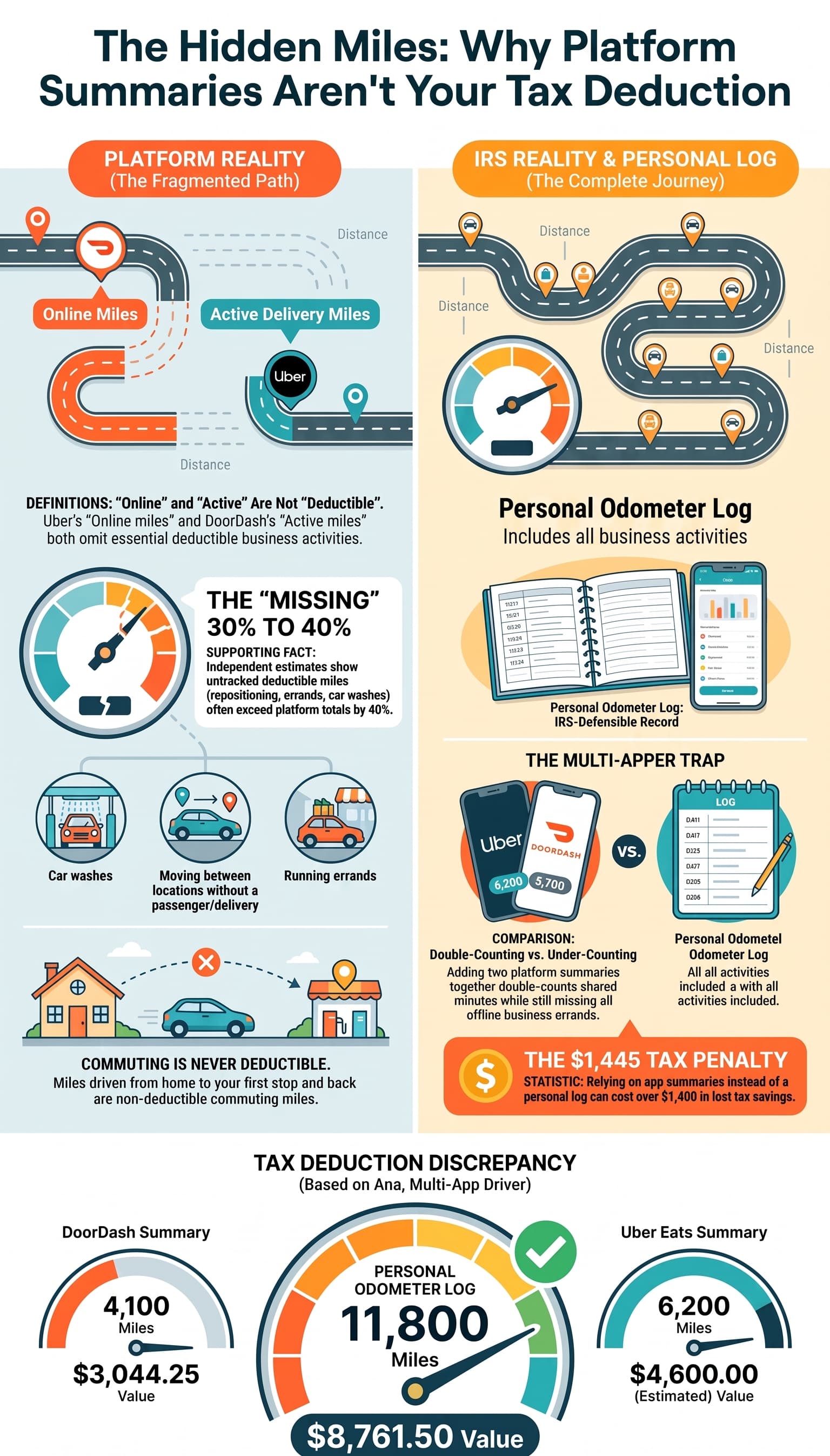
The mileage figure on your platform's annual tax summary is not your deduction. It is a measurement the platform took for its own purposes, with a label attached — "online miles", "active delivery miles", "on-trip miles" — and none of those labels means "miles you may deduct." Every one of them is smaller than the real number, by different amounts, and if you drive for two platforms at once, adding the two summaries together produces a figure that is too big and too small at the same time.
Read the label, because the platforms measure different things
The two labels you are most likely to be handed:
"Online miles" — what Uber reports on its annual tax summary. This is the broader of the two: miles driven waiting for a request, miles driving to a pickup, and miles with the passenger or order in the car. It is a genuinely useful number.
"Active delivery miles" — closer to what DoorDash's summary shows. This counts the delivery itself and leaves out the waiting, the repositioning, and in most accounts the miles between one drop-off and the next order.
The two words look interchangeable on a statement. They are not, and the gap between them is money. A driver who takes DoorDash's figure at face value is deducting a fraction of what they drove; a driver who takes Uber's is closer, but still short.
What is missing from even the generous number
The IRS test is business purpose, not whether an app was recording. So these are deductible and no platform can see them:
- Miles with the app off that were still for the business. Driving to have the car cleaned because you drive strangers for a living. Collecting an insulated bag. A trip to the mechanic for a repair the business caused.
- Repositioning before you go online. If you drive twenty minutes to a busy zone and then tap "go online", the platform's clock starts after the driving stopped.
- Any mile driven while you were logged into a different app. More on this below, because it is the one that catches multi-appers.
And a category that is not deductible, however tempting: the drive from home to wherever you start, and home again at the end. That is commuting, and self-employment does not change it. Log those separately from the beginning — separating them a year later is guesswork nobody can defend.
Independent estimates of the gap for rideshare drivers put the untracked portion at roughly 30% to 40% more than the platform's own figure. That is a rule of thumb for sanity-checking your own log, not a number to deduct. You cannot claim a percentage uplift on a platform's summary; you can only claim what you recorded.
The multi-apper problem: wrong in both directions at once
Here is the case that no platform summary can be fixed into shape.
Ana runs Uber Eats and DoorDash simultaneously, both apps on, taking whichever order comes first. At the end of the year:
| Source | Miles | What it actually measured |
|---|---|---|
| Uber Eats annual summary | 6,200 | Online miles — waiting, en route, delivering |
| DoorDash annual summary | 4,100 | Active delivery miles only |
| The two added together | 10,300 | The same minutes, counted twice over |
| Ana's own odometer log | 11,800 | Every business mile she drove |
Both apps were running during most of her shifts, so a large share of those 6,200 and 4,100 miles are the same miles. Adding them double-counts. But each figure is also missing her waiting time, her repositioning, and the mileage on days she was doing business errands with both apps off.
So the sum is too high, each individual number is too low, and no arithmetic on those two figures produces the right answer. The only number that is right is the one she kept herself.
What the difference is worth
Ana's 11,800 miles fell roughly evenly either side of the mid-year rate change — the 2026 rate is $0.725 through June 30 and $0.76 from July 1:
| Period | Miles | Rate | Deduction |
|---|---|---|---|
| January – June | 5,900 | $0.725 | $4,277.50 |
| July – December | 5,900 | $0.76 | $4,484.00 |
| Her deduction | 11,800 | $8,761.50 |
Had she filed on DoorDash's 4,100 alone — which is what happens when somebody dashes on one app and takes the summary as gospel — the same split gives $3,044.25.
The difference is $5,717.25 of deduction. At 15.3% self-employment tax on 92.35% of it, plus a 12% marginal bracket on what is left after the deductible half of the SE tax:
- Self-employment tax: $5,717.25 × 92.35% × 15.3% = $808
- Income tax: ($5,717.25 − $404) × 12% = $638
About $1,445 in tax, from the difference between a number somebody else measured and a number she kept.
So what is the platform's number for?
It is a floor and a cross-check, and it is good at that job.
If your own log says 7,000 miles and the platform says 9,400, your log is missing shifts and you should find out which. If your log says 14,000 and the platform says 6,200, that gap needs an explanation — waiting time, repositioning, a second app, business errands — and it should be visible in the log itself, not assembled afterwards.
What the summary cannot be is the record. The IRS expects a contemporaneous log: the date, the distance, where you went and why. A third party's record of its own transactions is evidence about those transactions, not about the miles it never saw.
Frequently Asked Questions
I did not keep a log this year. Can I just use the platform's number?
You can use it as the basis of a reconstruction, and it beats nothing — but understand the trade. A reconstructed figure is weaker evidence than a contemporaneous one, and the platform's number is an undercount, so you claim less than you were owed while holding weaker support for it. Pull everything you can date: trip histories, fuel records, calendar entries. Then start a real log tomorrow. This year is a salvage job; next year need not be.
Do I need odometer readings, or is a tracking app enough?
An app is fine, and in practice better than paper because it records as you go. What matters is that each trip carries a date, a distance, a destination and a business purpose, and that it was written down at the time. Keep the app's exported data somewhere it survives your changing phones — an annual export is worth more than a subscription you cancel in March.
I ran two apps at once. How do I count that?
By your odometer, not by either app. A mile driven while both apps were on is one deductible mile, not two, and neither summary knows the other exists. Log the shift once, from your own reading, and note in the log that you were multi-apping — that note is what explains the gap between your figure and both summaries.
Is the drive from home to where I start deductible?
Generally not. Driving from home to your first work location and back at the end is commuting, and being self-employed does not change that. Miles once you are online and available, and miles between jobs, are business miles. If you have a qualifying home office the picture changes, but that is a separate test with its own requirements — do not assume it.
What about miles when the app was off?
Deductible if the trip had a genuine business purpose: the car wash because you carry passengers, the shop for a delivery bag, the garage for a repair. Log them the same way as everything else, with the purpose written down. The app being off is not the test; the reason for the trip is.
I already filed using the platform's figure. What now?
An amended return is the mechanism, but the question is whether you can now support the larger number — an amendment claiming miles you cannot document is worse than the original. If platform trip histories, bank records and a calendar together evidence the extra driving, take them to a preparer. If you have nothing but a belief that you drove more, leave it and keep a log from today.
Work Out What Your Driving Is Actually Earning
Once you have the real mileage figure, the interesting question is what the driving pays after it. The mileage deduction reduces your tax; the fuel and the wear reduce your bank balance, and those are not the same number.
The Gig Worker Calculator takes your weekly earnings, hours and miles and returns what the work is really worth per hour once the vehicle and the self-employment tax are accounted for.