There's a version of this decision that happens in a single frustrated moment — a bad day at work, a side hustle that just had its best month ever, and the very real temptation to hand in your notice on the spot. There's also a version that happens methodically, with real numbers behind it. The second version is the one that actually works out.
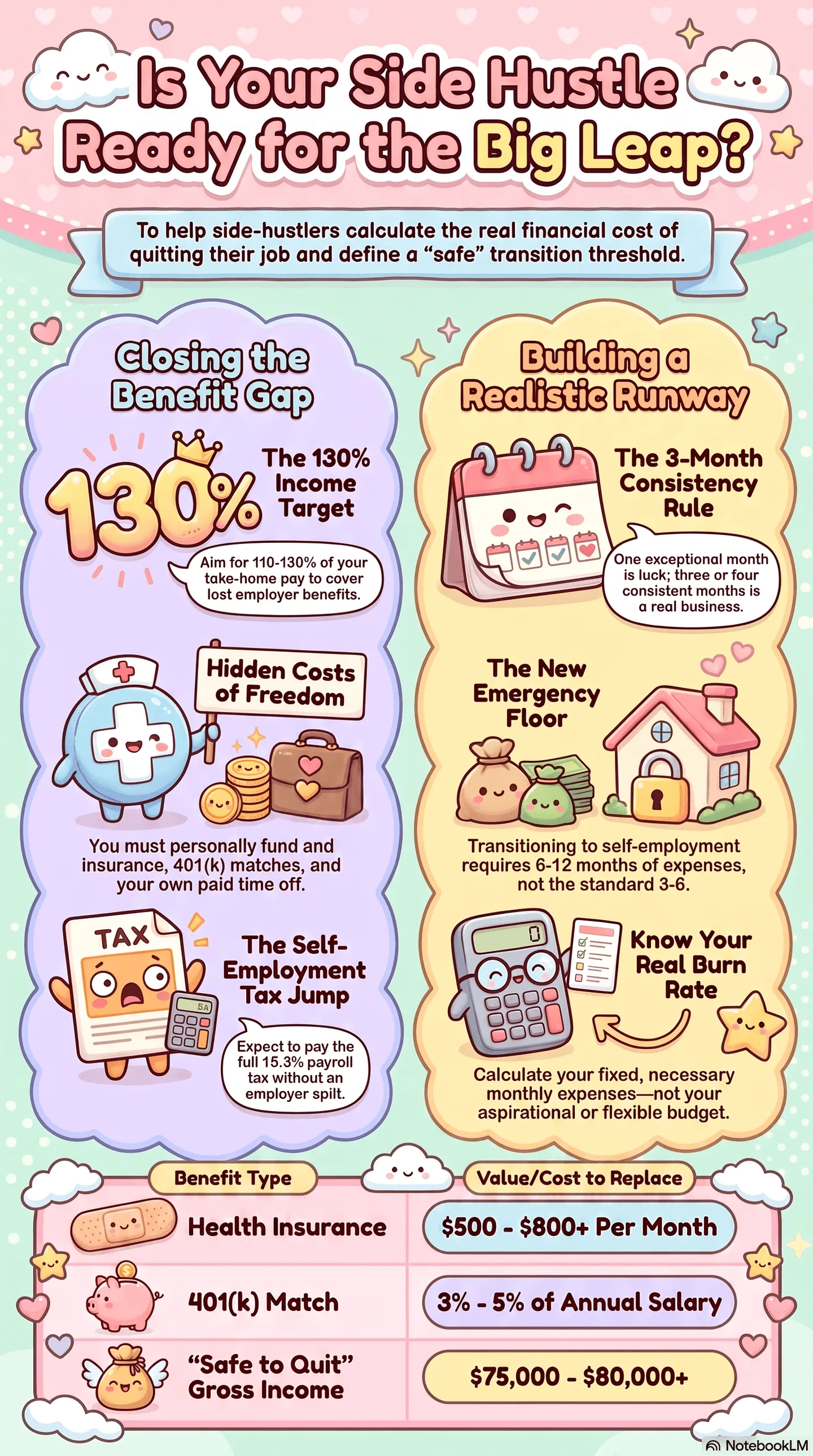
The Income Comparison Almost Everyone Gets Wrong
The most common mistake is comparing side hustle income to salary — as in, "my side hustle made $4,500 last month, and my job pays $4,500 a month after taxes, so I'm ready." This comparison misses several real costs that only show up once you've already quit:
- Employer-sponsored health insurance — often worth $500-$800+/month to replace on your own, sometimes more depending on your plan and location
- Employer 401(k) match — typically 3-5% of salary that simply disappears
- Paid time off — 2-3 weeks of PTO represents real paid non-working time you're currently getting for free
- The employer-side half of payroll taxes — as a self-employed person, you now pay the full 15.3% self-employment tax instead of splitting it with an employer
A side hustle income that matches your take-home pay isn't actually a like-for-like replacement — it's usually short by the value of these benefits, which can easily add up to 15-25% of your total compensation package depending on your specific job.
The Emergency Fund Number Has Changed
The traditional advice — 3 to 6 months of expenses saved before making a major income transition — was calibrated for a labor market that no longer fully exists. Financial planners increasingly point to longer job-search timelines, higher healthcare deductibles, and the reality that freelance and side hustle income is less stable in the early months than people expect when calculating how much runway is actually needed.
For someone transitioning from steady W-2 income to self-employment specifically, the common professional guidance is that the standard 3-6 month employee guideline should function as a floor, not a target — with many advisors now recommending 6-12 months of expenses for people making this specific kind of transition, given that client acquisition takes real time and a slow first quarter shouldn't be able to end the business before it starts.
Beyond the Numbers: Proof of Concept
Financial readiness isn't only about the size of your bank account — it's also about whether your income is demonstrated, not projected. A single exceptional month tells you much less than three or four consistent months at your target income level. One good month can be a lucky client, a viral post, or a seasonal spike. Three or four consistent months is a business.
Common mistakes people make when evaluating their own readiness include underestimating how long it takes to build a truly sustainable side income while overestimating how quickly new client or customer flow will materialize once they're full-time — and forgetting to price their work as a professional business rather than a hobby that happened to make some money.
The Debt and Cash Flow Check
Before making the leap, two additional checks matter beyond the emergency fund itself:
- High-interest consumer debt. Carrying significant credit card debt into a period of variable income is a specific risk — you can't reliably service debt payments on income that fluctuates month to month the way you could on a predictable salary.
- Know your actual monthly burn rate. Not your income, not your aspirational budget — your real fixed and necessary monthly expenses (rent/mortgage, utilities, food, insurance, minimum debt payments). This number, not your side hustle's best month, is the baseline your side income needs to clear consistently.
What This Looks Like in Practice
Someone earning $65,000 at their day job, with standard benefits (health insurance, a 4% 401k match, two weeks PTO), needs their side hustle to consistently clear roughly $75,000-$80,000 in gross income to genuinely replace their full compensation package — not $65,000. Add a 25% safety buffer for income variability, and the real "safe to quit" threshold moves higher still.
This is the exact calculation our Side Hustle Quit Calculator runs for your specific situation — entering your salary, benefits, monthly expenses, and current side income to show your true replacement income threshold and a realistic timeline based on your income growth rate, rather than a rule of thumb that may not fit your circumstances.
A Gradual Transition Is Often Underrated
Quitting isn't binary. Options that reduce risk meaningfully include negotiating reduced hours or a part-time arrangement with your current employer while scaling the side income, taking an unpaid leave of absence to test full-time self-employment before fully resigning, or timing your exit around a natural transition point like the end of a project or a review cycle. The all-or-nothing framing — where "ready to quit" means walking in cold turkey the moment income crosses a number — is common in how this decision gets discussed, but it isn't the only path, and it isn't always the lowest-risk one.
Frequently Asked Questions
How much side income do I need before quitting, as a rule of thumb? There's no single universal number, because it depends heavily on your specific salary, benefits package, and cost of living — but a common framework is to target your side income consistently matching 110-130% of your current take-home pay for at least 3 consecutive months, to account for lost benefits and income variability. Our Side Hustle Quit Calculator builds this calculation using your actual numbers rather than a generic percentage.
Should I quit as soon as my side income matches my salary? Generally not recommended, for two reasons: matching your salary doesn't account for the value of lost benefits (health insurance, retirement match, PTO), and a single month of matching income doesn't demonstrate that the income is stable and repeatable. Most financial advisors recommend seeing your target income level maintained for multiple consecutive months before treating it as reliable.
What's the biggest financial mistake people make when quitting for a side hustle? Underestimating both sides of the equation simultaneously — underestimating how long it takes for a new full-time business to reach stable income, while overestimating how quickly new revenue will materialize once they have more time to dedicate to it. This combination is what turns a promising side hustle into a financially stressful first year of full-time self-employment.
Does building an emergency fund come before or after growing my side hustle? Both can happen simultaneously, but the emergency fund shouldn't be skipped in favor of aggressive business investment. Financial planning guidance generally treats the emergency fund as the foundation that protects your ability to make calm, non-desperate decisions — including the decision of when to actually quit — rather than something to build only after the side hustle is already thriving.