If your side hustle only brought in a few hundred dollars this year, it's tempting to assume it's too small to matter for taxes. The IRS disagrees — and the threshold where they start caring is a lot lower than most people expect.
The $400 Rule, Straight From the IRS
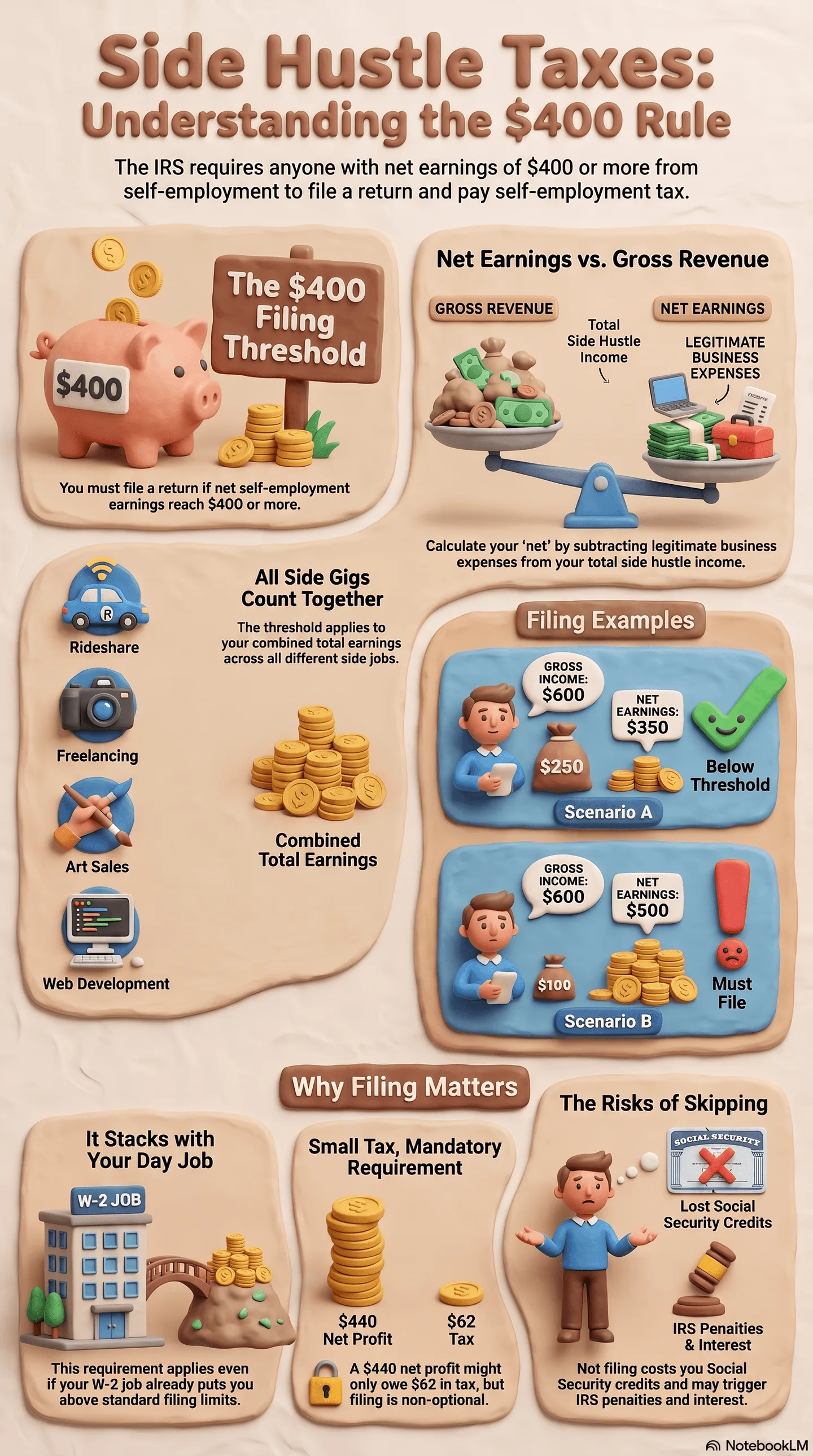
According to the IRS's own guidance (Topic No. 554 and the Schedule SE instructions), you must pay self-employment tax and file a return if your net earnings from self-employment are $400 or more — regardless of your age, filing status, or how much other income you have. This isn't a rounding guideline or a rule of thumb; it's a specific, longstanding IRS threshold.
Note the phrase "net earnings" — that's your side hustle income after subtracting legitimate business expenses, not your gross revenue. If you sold $600 worth of crafts but spent $250 on materials, your net earnings are $350, which falls under the threshold. If you spent only $100, your net earnings are $500, and the rule applies.
Why "I Already Have a Day Job" Doesn't Change This
Here's the part that surprises people: the $400 self-employment threshold applies on top of your regular filing requirements, not instead of them. Your W-2 job might already put you well above the standard filing threshold ($15,750 for single filers in 2026), which means you're already required to file a return regardless. The $400 rule specifically triggers the requirement to complete Schedule SE and pay self-employment tax on that side income — separate from your regular income tax filing.
In other words: if you have a day job and $500 in net side hustle income, you're not just adding $500 to a return you'd already file — you're specifically required to calculate and pay self-employment tax on that portion, because it crossed the $400 line.
The Exact Technical Detail Most Guides Miss
There's a precise calculation buried in the IRS's own Schedule SE instructions that's worth knowing: because self-employment tax is calculated on 92.35% of your net earnings (not the full amount), the IRS instructions specify that if your net earnings multiplied by this factor come to $434 or more, you file Schedule SE. Below that combined figure, you generally don't need to. This is a small but precise detail — the "$400 rule" people talk about is really the input number; $434 is closer to the actual line where the paperwork requirement kicks in after the calculation.
For practical purposes, treating $400 in net earnings as your trigger point is the right mental model — the $434 figure is a downstream technical detail in how the form itself is calculated, not a different threshold you need to separately track.
What Happens If You Skip Filing on a Small Side Hustle
Skipping the filing requirement on side income under the assumption that it's "too small to matter" carries real consequences:
- You lose Social Security and Medicare credit accumulation. Self-employment tax is how the IRS credits your side hustle earnings toward your future Social Security benefits. Skip the tax, skip the credit.
- The IRS may still know about the income anyway. If a client issued you a 1099-NEC, or a platform reported your payments, the IRS has a record even if you don't file to match it.
- Penalties and interest accrue on unpaid amounts, even if the total tax owed is small in absolute dollars.
- You lose the opportunity for legitimate deductions. You can only claim business expenses against side hustle income by actually reporting the income and filing Schedule C — skipping the filing means forfeiting deductions you were entitled to.
A Realistic Example
Someone earns $38,000 from a W-2 job and starts a weekend photography side business, bringing in $800 in gross revenue over the year. After deducting $360 for a camera lens and software subscriptions, net earnings come to $440.
That $440 crosses the $400 threshold. This person owes self-employment tax on that amount (roughly 15.3% × 92.35% × $440 ≈ $62 in SE tax) plus ordinary income tax on the same $440 at their marginal rate, which — since their W-2 income already fills the lower brackets — stacks at whatever rate applies to their last dollar earned (see our related article on marginal rate stacking for how this works). The dollar amounts here are small, but the filing obligation is not optional.
When You're Genuinely Under the Threshold
If your net side hustle earnings are clearly and provably under $400 for the year, you're not required to file Schedule SE on that basis alone. But two things still matter:
- Keep records anyway. If you're close to the line, good expense tracking is what determines whether you're at $380 or $420 — and that distinction has real consequences.
- Other filing requirements might still apply. Being under the $400 self-employment threshold doesn't exempt you from filing if your total income (W-2 plus side income) exceeds your standard filing threshold for other reasons.
Use our Side Hustle Tax Calculator to see exactly what you'd owe on your specific side income, whether you're right at the threshold or well above it.
Frequently Asked Questions
Does the $400 rule apply per side hustle, or to all my side income combined? It applies to your total net self-employment earnings across all self-employment activities combined, not per individual gig or platform. If you earn $250 from freelance writing and $200 from selling crafts, your combined net earnings of $450 crosses the threshold — even though neither activity alone would have.
I only made $350 from my side hustle. Do I need to report it at all? If your net earnings are genuinely under $400, you're not required to file Schedule SE specifically for self-employment tax on that basis. However, if you have other income (like a W-2 job) that already requires you to file a return, you generally still need to report all your income, including this smaller amount, on that return.
Does receiving a 1099-K or 1099-NEC change the $400 threshold? No — the $400 self-employment threshold is about your net earnings, not about which tax forms you receive. You can owe self-employment tax on $400+ in net earnings even if no 1099 form was ever issued, and conversely, receiving a 1099 form doesn't automatically mean you owe self-employment tax if your net earnings after expenses are below $400.
Can I deduct expenses to get under the $400 threshold? You should deduct every legitimate business expense you actually incurred, regardless of whether it happens to bring you under the threshold — but you can't invent or inflate expenses just to avoid the filing requirement. If your genuine net earnings after real expenses land under $400, that's a natural result of accurate accounting, not a strategy to engineer.