If you're self-employed, there's no employer offering short-term or long-term disability coverage as a benefit — whatever protection exists, you have to arrange yourself, or you're relying entirely on Social Security Disability Insurance (SSDI). Most self-employed people have a rough sense that SSDI exists as a backstop, but a much vaguer sense of what it would actually pay out, which makes it hard to know whether private coverage is worth the premium.
Do Self-Employed People Qualify for SSDI?
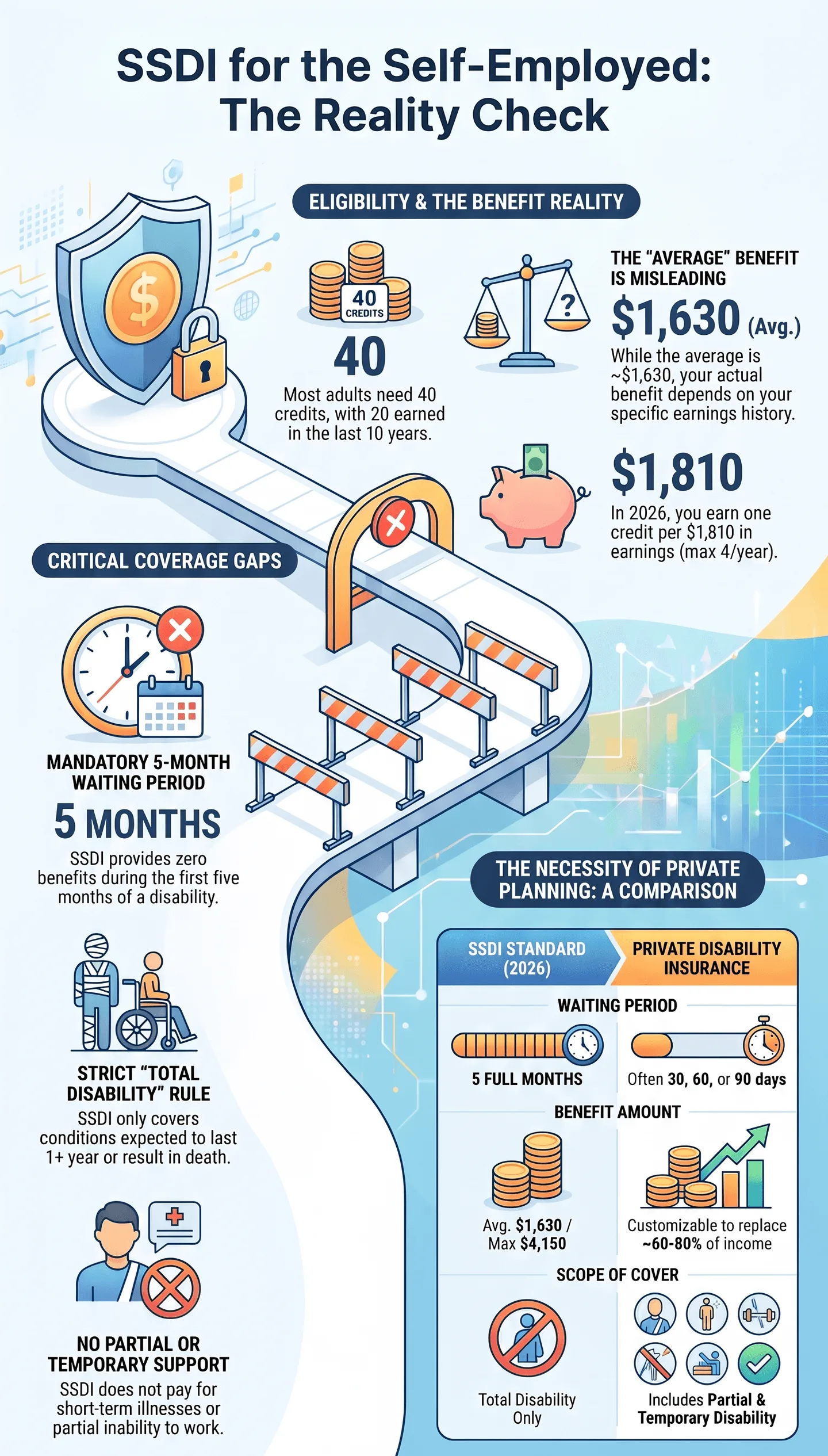
Yes, as long as you've paid Social Security and Medicare taxes through self-employment tax for enough of the required work credits. Most adults need 40 work credits total, with at least 20 earned in the 10 years immediately before becoming disabled — younger workers can qualify with fewer credits. In 2026, you earn one credit for each $1,810 in covered earnings, up to four credits per year, so a typical self-employed person paying SE tax consistently earns their full four credits annually without any special action required.
The practical implication: if you've been self-employed and paying SE tax for several years, you're very likely SSDI-eligible. The open question isn't usually eligibility — it's how much you'd actually receive.
How SSDI Benefits Are Actually Calculated
This is the part that trips people up. SSDI is often discussed using the national average monthly benefit, which sits at approximately $1,630. That figure is a reasonable shorthand for someone earning close to the national median income, but it's not a flat amount everyone receives.
Your actual benefit is calculated from your Average Indexed Monthly Earnings (AIME) — essentially, an inflation-adjusted average of your highest-earning working years — run through a formula that replaces a higher percentage of lower earnings and a lower percentage of higher earnings. The practical result: someone with a lower or shorter earnings history receives a benefit meaningfully below the "average" figure, and someone with a long history of higher earnings receives more than the average, up to a maximum (approximately $4,150/month in 2026 for someone claiming at full retirement age with maximum taxable earnings).
For a freelancer or gig worker earning below the national median, this means the real SSDI estimate is often lower than the number people tend to repeat casually — and for someone newer to self-employment with a shorter earnings history, it can be lower still.
What SSDI Doesn't Cover
Even at the correct, personalized estimate, SSDI has gaps worth knowing about regardless of your income level:
- A five-month waiting period. SSDI doesn't pay benefits for the first five full months after your disability began, regardless of how severe the disability is.
- A strict definition of "disabled." SSDI requires that you're unable to perform substantial gainful activity due to a condition expected to last at least a year or result in death — it's not designed for partial or temporary disabilities, which is where most real-world disability claims actually fall.
- No inflation protection during the waiting period, and modest annual cost-of-living adjustments afterward that may not track your actual expenses.
How to Think About Private Disability Insurance
Private disability insurance is generally structured to fill the gap between what SSDI would pay (using your real, income-adjusted estimate — not the national average) and what you'd actually need to cover your expenses. It also typically covers a broader definition of disability, including partial and temporary conditions that SSDI wouldn't pay out for at all.
The decision isn't simply "get a policy" or "rely on Social Security" — it depends on your specific income level, expenses, existing savings, and how much risk you're comfortable carrying yourself versus transferring to an insurer through a monthly premium.
Sources: Social Security Administration, Disability Benefits (2026); SSA Annual Statistical Supplement, average and maximum benefit figures.
Frequently Asked Questions
How many work credits do I need to qualify for SSDI as a self-employed person? Most adults need 40 total work credits, with at least 20 earned in the 10 years before becoming disabled. In 2026, you earn one credit per $1,810 in covered self-employment earnings, up to four credits a year — younger workers can qualify with fewer total credits.
Is the "average" SSDI benefit a reliable number to plan around? Not for everyone. It's a reasonable estimate for someone earning close to the national median income, but SSDI is calculated from your own earnings history, so it understates the benefit for higher earners and can overstate it for lower earners or those newer to self-employment.
How long is the waiting period before SSDI benefits start? Five full months from the onset of the disability. No benefits are paid during that window regardless of the severity of the condition.
Does private disability insurance replace SSDI, or work alongside it? Typically alongside it. Most private policies are priced and structured assuming SSDI will also be in place, covering the gap between the two rather than duplicating the full income replacement on their own.
Can I get disability insurance if I'm newer to self-employment with irregular income? It's generally possible but can be more complex — insurers often want an income history to underwrite the policy accurately. Some freelancers in their first year or two choose to prioritize an emergency fund first and revisit private coverage once income stabilizes.