The S-Corp reasonable salary requirement is where most solopreneurs make their biggest mistake — and where the IRS focuses its audit attention. Set your salary too low, and you're inviting an audit that can wipe out years of tax savings. Set it too high, and you eliminate the benefit of S-Corp entirely. This guide walks you through how to find the right number and document it so it holds up if you're ever questioned.
Before diving into salary strategy, confirm your S-Corp structure makes financial sense with our LLC vs S-Corp Tax Savings Calculator.
What "Reasonable Salary" Actually Means
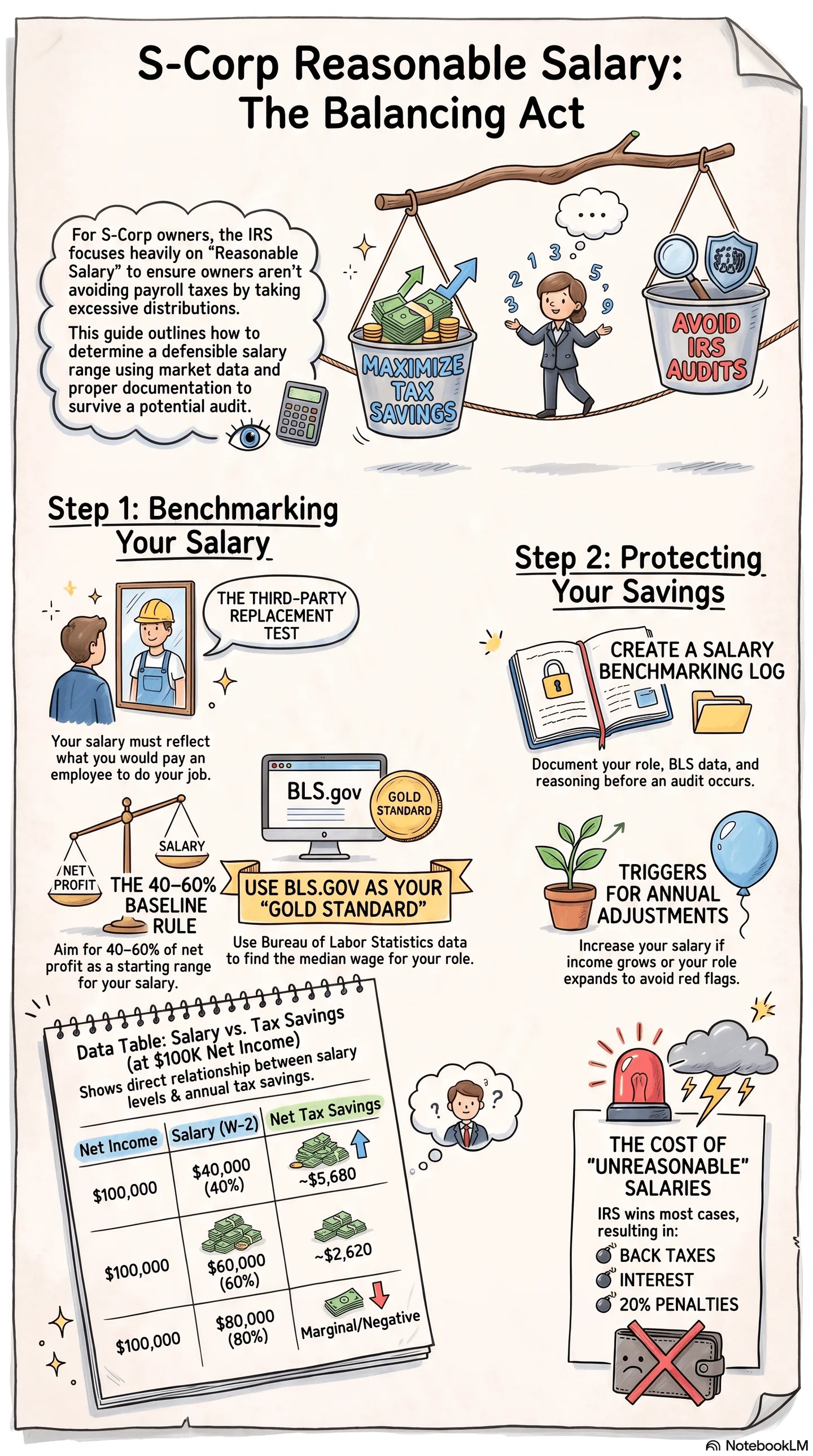
The IRS requirement is straightforward in concept: S-Corp owner-employees must pay themselves a salary that reflects what they would pay a third-party employee to perform the same services. What's not straightforward is how to determine that number for a solo service business where you're the only employee doing everything.
The IRS doesn't publish a formula or specific percentage. What they do is audit S-Corp returns where the owner's salary looks artificially low relative to the total distributions taken. If challenged, the burden falls on you to prove your salary was reasonable — which means having documentation ready before you're asked for it.
Why This Is the #1 S-Corp Audit Trigger
The tax savings from S-Corp come entirely from the distribution portion of your income — distributions don't trigger payroll or self-employment tax. This creates an obvious incentive to minimize your salary (and therefore your payroll taxes) and maximize distributions.
The IRS knows this. They have data on what S-Corp owners in various industries and income levels pay themselves, and they flag returns that deviate significantly from norms. Tax Court cases on this issue are common, and the IRS wins the vast majority of them when the salary is clearly unreasonable.
A few high-profile examples: A dentist paying themselves $24,000 while taking $269,000 in distributions. A financial advisor paying $18,000 while distributing $978,000. An attorney paying zero salary. All three were successfully challenged by the IRS and required to pay back taxes, penalties, and interest — often erasing several years of S-Corp savings.
The Reasonable Salary Framework: Three Approaches
Approach 1: BLS Occupational Employment Statistics (Most Defensible)
The Bureau of Labor Statistics publishes wage data for hundreds of occupations at the national, state, and metro-area level. This is the most credible external source for establishing a reasonable salary range because it's government data, industry-neutral, and updated annually.
How to use BLS data:
- Go to bls.gov/oes (Occupational Employment and Wage Statistics)
- Search for your occupation by title or Standard Occupational Classification (SOC) code
- Review the median and percentile wages for your occupation nationally and in your state/metro area
- Document the specific data you found, the date you accessed it, and how it relates to your role
Example occupations and 2025 national median wages (use current year data when you file):
| Occupation | National Median Annual Wage | 75th Percentile |
|---|---|---|
| Software Developers | $132,270 | $168,570 |
| Management Consultants | $99,800 | $141,690 |
| Graphic Designers | $59,410 | $79,040 |
| Web Developers | $95,380 | $127,080 |
| Market Research Analysts | $74,680 | $106,030 |
| Writers and Authors | $73,690 | $109,670 |
| Accountants and Auditors | $79,880 | $108,500 |
Approach 2: Industry Surveys and Job Boards
Glassdoor, LinkedIn Salary, Indeed, and Payscale all publish salary data by job title, location, and experience level. These sources are less authoritative than BLS but provide additional data points that strengthen your documentation.
Best practice: use at least two sources (BLS plus one job board) and document both. A range from multiple sources is more defensible than a single data point.
Approach 3: What You Would Pay Someone Else
Ask yourself: if you needed to hire someone to do all the work you personally do in this business, what would you pay them? This is the fundamental IRS standard. For a solo consultant billing at $150/hour, the salary should reflect what a senior consultant position pays — not a junior employee rate.
The 40–60% Rule: A Starting Framework
While there's no IRS-sanctioned percentage, many CPAs use 40–60% of net S-Corp profit as a reasonable starting range for salary. Here's why this works as a baseline:
- It results in a salary that's in a plausible range for most professional services businesses
- It leaves enough in distributions for S-Corp to be financially worthwhile
- It aligns roughly with how employee compensation typically relates to business revenue in service businesses
Important: This is a starting point for your research, not a rule. Your actual salary should be cross-referenced against BLS data for your specific role. A freelance graphic designer earning $80,000 net shouldn't necessarily pay themselves 40–60% of that if BLS data shows median graphic designer salaries are $59,000 — the BLS data provides independent corroboration.
What Factors Can Justify a Lower Salary
Sometimes a salary below the BLS median is defensible:
- Part-time operation: If you only work 20 hours per week, a salary below full-time equivalents is appropriate
- Passive or investment income component: If your S-Corp profit includes significant passive returns (licensing, residuals), a lower salary on the active portion may be defensible
- Early stage with minimal profit: If net profit is $50,000 and your BLS comparable is $85,000, a salary of $50,000 (essentially 100%) may be appropriate — you can't pay yourself more than you earn
- Capital-intensive business: When profit is partly attributable to capital investment rather than just your personal services, salary can be proportionally lower
Creating Your Salary Benchmarking Log
Documentation is as important as the salary number itself. If you're audited, you need to show your reasoning — not just assert that your salary was reasonable. Create a simple document with these components:
- Your role description: 2–3 sentences describing what you actually do in the business
- Comparable occupation identified: The BLS occupation title and SOC code most similar to your work
- BLS wage data: The median, 25th percentile, and 75th percentile wages, with the date accessed and URL
- Secondary source: Glassdoor or similar data for the same role
- Your salary selected and why: How you landed on your specific number from within the range
- Your experience and qualifications: Years of experience, credentials, and client base that position you within the salary range
Update this document each year when you set or adjust your salary. The audit window is typically 3 years from filing, so maintain documentation for at least that long.
How Salary Affects Your S-Corp Tax Savings
Your salary directly determines how much you save with S-Corp. Here's the relationship:
| Net Income | Salary | Distribution | Payroll Tax Saved | Net Savings (after compliance) |
|---|---|---|---|---|
| $100,000 | $40,000 (40%) | $60,000 | ~$9,180 | ~$5,680 |
| $100,000 | $60,000 (60%) | $40,000 | ~$6,120 | ~$2,620 |
| $100,000 | $80,000 (80%) | $20,000 | ~$3,060 | Marginal or negative |
| $150,000 | $70,000 (47%) | $80,000 | ~$12,240 | ~$8,740 |
The lower your salary (within reasonable limits), the higher your savings. But the savings must be weighed against audit risk — a salary that's too low for your profession invites scrutiny that could cost more than it saved.
Annual Review: When to Adjust Your Salary
Your S-Corp salary should be reviewed at least annually. Triggers for adjustment:
- Your net income increases significantly (your salary should grow proportionally)
- You expand the scope of services you provide
- BLS wage data for your occupation increases meaningfully
- You bring on significant passive income that changes the profit mix
Setting a salary once and never adjusting it is itself a red flag. IRS data shows that S-Corp owners who adjust their salaries over time have lower audit rates than those who maintain a static salary despite growing income.
Check Your S-Corp Readiness
Salary strategy is just one of five dimensions of S-Corp readiness. Use our S-Corp Readiness Assessment to evaluate where you stand across all five — and get a personalized action plan before filing Form 2553.
Frequently Asked Questions
What happens if the IRS challenges my S-Corp salary?
If the IRS determines your salary was unreasonably low, they can reclassify distributions as wages, making them subject to back payroll taxes. You'd owe the employee and employer payroll tax on the reclassified amount, plus interest (currently 7–8% annually), plus a potential 20% accuracy-related penalty. The combined cost can easily exceed multiple years of S-Corp savings.
Is there a minimum salary required for S-Corp?
No IRS-mandated minimum exists. However, paying yourself $0 salary while taking distributions is virtually guaranteed to trigger a challenge. Even "token" salaries of $10,000–$20,000 for businesses earning $200,000+ have been successfully challenged. The standard is what the work you perform would actually command in the marketplace.
Can I change my salary mid-year?
Yes — you can adjust your salary through payroll at any time. If your business does significantly better or worse than expected, adjusting your salary mid-year is both allowed and reasonable. Just make sure any adjustment is documented and aligns with updated market data.
Does my salary affect my Social Security benefits at retirement?
Yes. Social Security retirement benefits are calculated based on your lifetime wages — specifically your W-2 earnings. Distributions don't count toward Social Security credits. An S-Corp owner who consistently pays themselves a very low salary may receive lower Social Security benefits in retirement. For high earners, the payroll tax savings often exceed the reduction in future benefits, but it's worth facto