The difference between receiving a 1099 and a W-2 isn't just a paperwork distinction — it fundamentally changes how you're taxed, what you can deduct, and how much you ultimately take home on the same gross income. This guide gives you the complete picture for 2026.
The Fundamental Difference
When you're a W-2 employee:
- Your employer withholds income tax, Social Security, and Medicare from every paycheck
- Your employer pays an additional 7.65% in payroll taxes on your behalf (the employer's share)
- You receive benefits (health insurance, retirement match, paid leave) as additional compensation
- You file taxes once a year and typically get a refund if withholding exceeded your liability
When you're a 1099 contractor:
- You receive gross payments with zero withholding
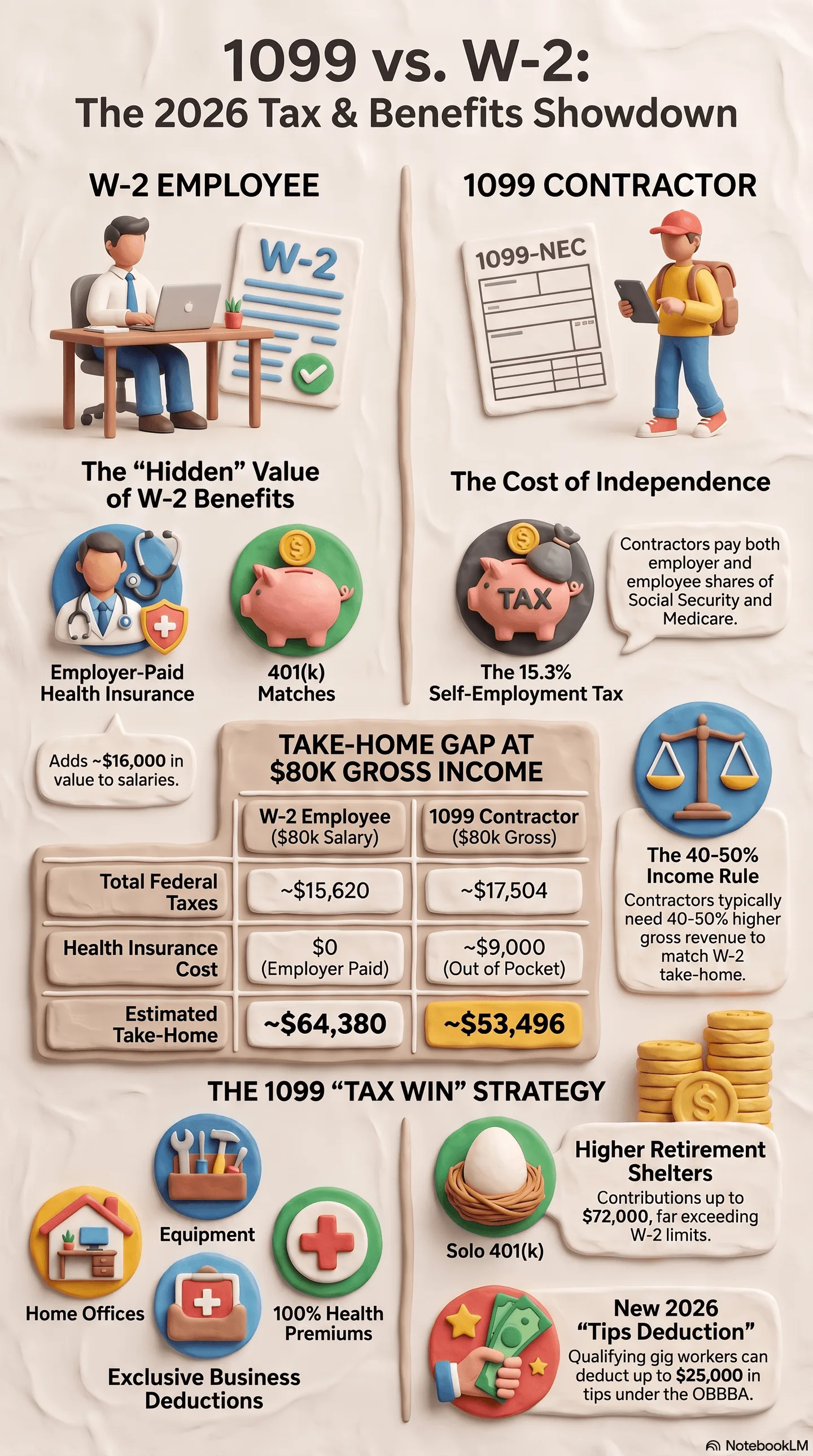
- You pay both the employee and employer share of Social Security and Medicare — the full 15.3%
- You fund all your own benefits
- You must make estimated quarterly tax payments to avoid penalties
- You can deduct legitimate business expenses to reduce your taxable income
The Tax Rate Reality: How Much More Do 1099 Workers Pay?
The short answer: at the same gross income, a 1099 worker typically pays 7–12% more in total taxes than a W-2 employee — before accounting for business deductions that can partially offset this.
Here's why the gap exists:
Self-employment tax (the hidden extra cost)
A W-2 employee earning $80,000 pays 7.65% in FICA taxes ($6,120). Their employer pays another $6,120 — but the employee never sees this. A 1099 contractor earning $80,000 pays the full 15.3% ($12,240) themselves. The difference: $6,120 per year that W-2 employees receive for free.
2026 tax comparison at $80,000 gross income
| Tax Item | W-2 Employee ($80,000 salary) | 1099 Contractor ($80,000 gross) |
|---|---|---|
| FICA/SE tax paid by worker | $6,120 (7.65%) | $11,304 (15.3% on 92.35%) |
| Standard deduction | $16,100 (single, 2026) | $16,100 (single, 2026) |
| SE tax deduction | N/A | -$5,652 (50% of SE tax) |
| QBI deduction (20%) | N/A | -$11,650 (20% of net income after SE deduction) |
| Federal taxable income | ~$63,900 | ~$47,048 |
| Federal income tax (est.) | ~$9,500 | ~$6,200 |
| Total federal tax | ~$15,620 | ~$17,504 |
| Effective rate on gross income | ~19.5% | ~21.9% |
The difference at $80,000: ~$1,884 more in federal taxes as a 1099 contractor. After adding business deductions, the gap can narrow — or widen if deductions aren't maximized.
What 1099 Workers Get That W-2 Employees Don't
The tax disadvantage of 1099 work isn't the whole story. Self-employed workers get access to deductions and retirement accounts that W-2 employees can't use:
Business expense deductions
Every ordinary and necessary business expense reduces your net self-employment income — and therefore reduces both SE tax and income tax. W-2 employees cannot deduct most work-related expenses (the TCJA eliminated most employee deductions in 2018).
Home office deduction
A qualifying home office (used regularly and exclusively for business) lets you deduct a portion of rent/mortgage, utilities, and insurance. W-2 employees cannot claim this deduction, even if they work from home.
Self-employed health insurance deduction
100% of your health insurance premiums (if not eligible for employer coverage) are deductible above-the-line, reducing your AGI directly. This is worth $4,000–$15,000+ for most freelancers paying for their own coverage.
Retirement contributions
Solo 401(k) and SEP-IRA allow contributions up to $72,000 in 2026 — far exceeding what W-2 employees can contribute through employer plans. Maxing out a Solo 401(k) at $80,000 income can shelter $30,000–$40,000 from taxes.
Tips deduction (new in 2026 under OBBBA)
For qualifying self-employed workers in tip-eligible occupations, the OBBBA created a deduction of up to $25,000 in qualified tips from taxable income (2025–2028). This applies to certain gig workers, personal service providers, and other tip-receiving occupations.
The Real Comparison: What You Actually Take Home
To make a fair comparison between a $80,000 W-2 salary and $80,000 in 1099 income, you need to add the value of W-2 benefits to the salary:
| Component | W-2 ($80,000 salary) | 1099 ($80,000 gross) |
|---|---|---|
| Gross compensation | $80,000 | $80,000 |
| Employer-paid health insurance | +$9,000 (typical) | $0 (you pay this) |
| Employer 401(k) match (5%) | +$4,000 | $0 |
| Paid vacation (2 weeks) | +$3,077 | $0 (no revenue those weeks) |
| Total compensation value | ~$96,077 | $80,000 |
| Federal taxes | ~$15,620 | ~$17,504 (before deductions) |
| Health insurance cost | $0 (employer pays) | ~$9,000 |
| Estimated take-home | ~$64,380 | ~$53,496 |
This comparison shows why the common "freelancers earn more" assumption is misleading without accounting for benefits and tax differences. To actually take home the same as a $80,000 W-2 salary with benefits, a freelancer needs approximately $105,000–$115,000 in gross revenue.
When Does 1099 Work Win Financially?
Despite the tax disadvantage, 1099 work can come out ahead in three scenarios:
You charge significantly more per hour
If you charge $100/hour as a freelancer vs. earning the equivalent of $50/hour as an employee, the higher gross income more than compensates for the tax difference.
You maximize all available deductions
A W-2 employee at $80,000 with no deductions pays $15,620 in federal tax. A 1099 contractor at $80,000 who maximizes a Solo 401(k) ($30,000+ contribution), claims home office, health insurance, and business expenses might pay significantly less in total tax despite the SE tax disadvantage.
You elect S-Corp status at higher income levels
At $100,000+ in net income, S-Corp election can reduce the SE tax gap to near zero — and combined with business deductions and retirement contributions, a 1099/S-Corp structure can actually be more tax-efficient than W-2 employment for high earners. Use our LLC vs S-Corp Calculator to see the math for your income level.
The 1099 Tax Checklist
If you receive 1099 income, make sure you're doing all of this:
- Setting aside 25–30% of every payment for taxes
- Making quarterly estimated tax payments (Q3 deadline: September 15, 2026)
- Tracking all business expenses with receipts
- Contributing to a Solo 401(k) or SEP-IRA
- Deducting health insurance premiums
- Claiming the QBI deduction (20% of net business income)
- Evaluating whether S-Corp election makes sense at your income level
Use our Quarterly Tax Estimator to calculate your exact quarterly payment based on your net income after deductions.
Frequently Asked Questions
Do I owe taxes if I only received a 1099 for a small amount?
You must file Schedule SE and pay self-employment tax if your net self-employment earnings are $400 or more. Even if total SE tax is small, the filing requirement exists. The $400 threshold is very low — almost any freelance income triggers it.
Can a W-2 employee also have 1099 income?
Yes — having both is common. Your W-2 employer withholds taxes on your salary, but 1099 income has no withholding. You'll likely need to make quarterly estimated payments for your 1099 income, or increase your W-4 withholding at your W-2 job to cover the additional tax. The IRS allows either approach.
What is the 1099-NEC form and when do clients send it?
Form 1099-NEC (Non-Employee Compensation) is what clients send you when they paid you $600 or more during the year. For 2026, the threshold for 1099-K (third-party payment platforms like PayPal, Venmo, Stripe) remains at $20,000 and 200 transactions. Important: you owe tax on all self-employment income regardless of whether you receive a 1099 — the form is for reporting, not for determining what's taxable.
Is it better to be a W-2 employee or 1099 contractor?
It depends almost entirely on the rate differential. If you can charge 40–50% more as a 1099 contractor than your W-2 equivalent salary, the math often favors 1099 — especially at higher incomes with S-Corp election. If the gross compensation is similar, W-2 employment typically comes out ahead after accounting for benefits and SE tax. Use the True Hourly Rate Calculator to see your actual take-home at your current rate.